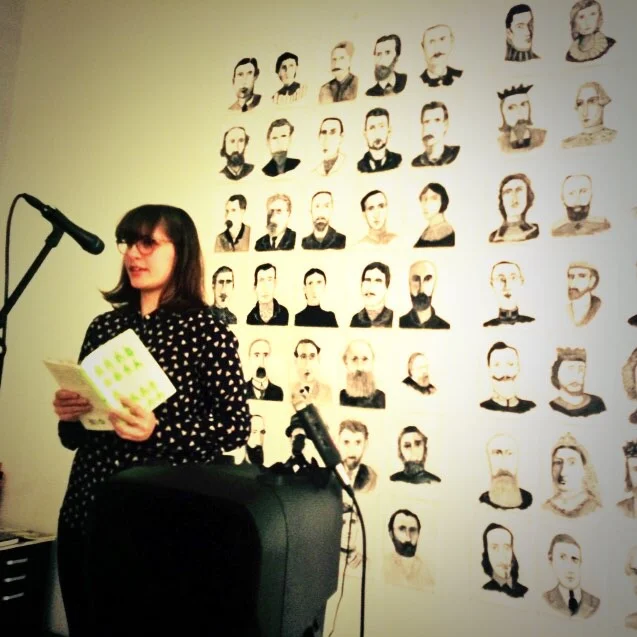
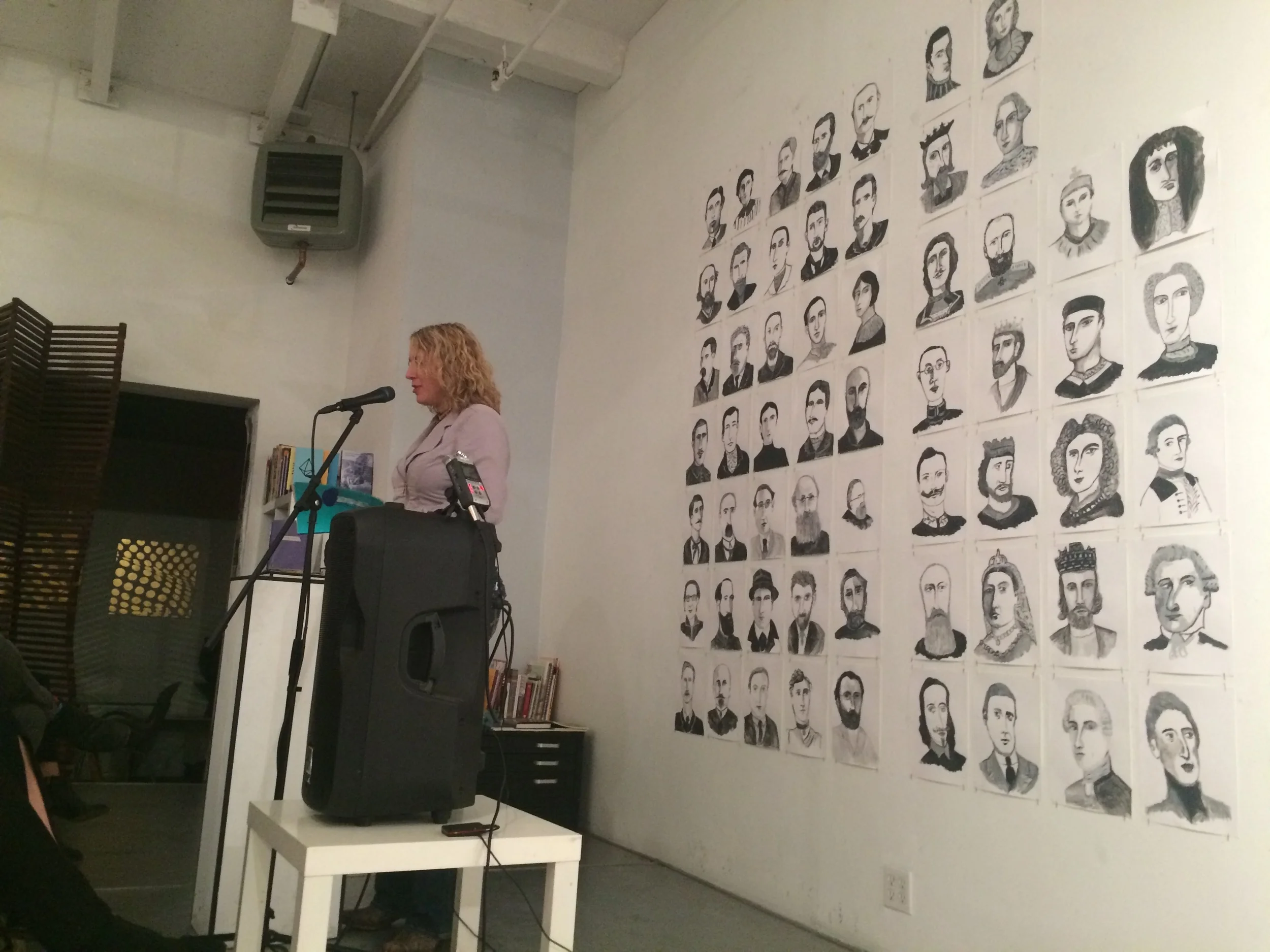
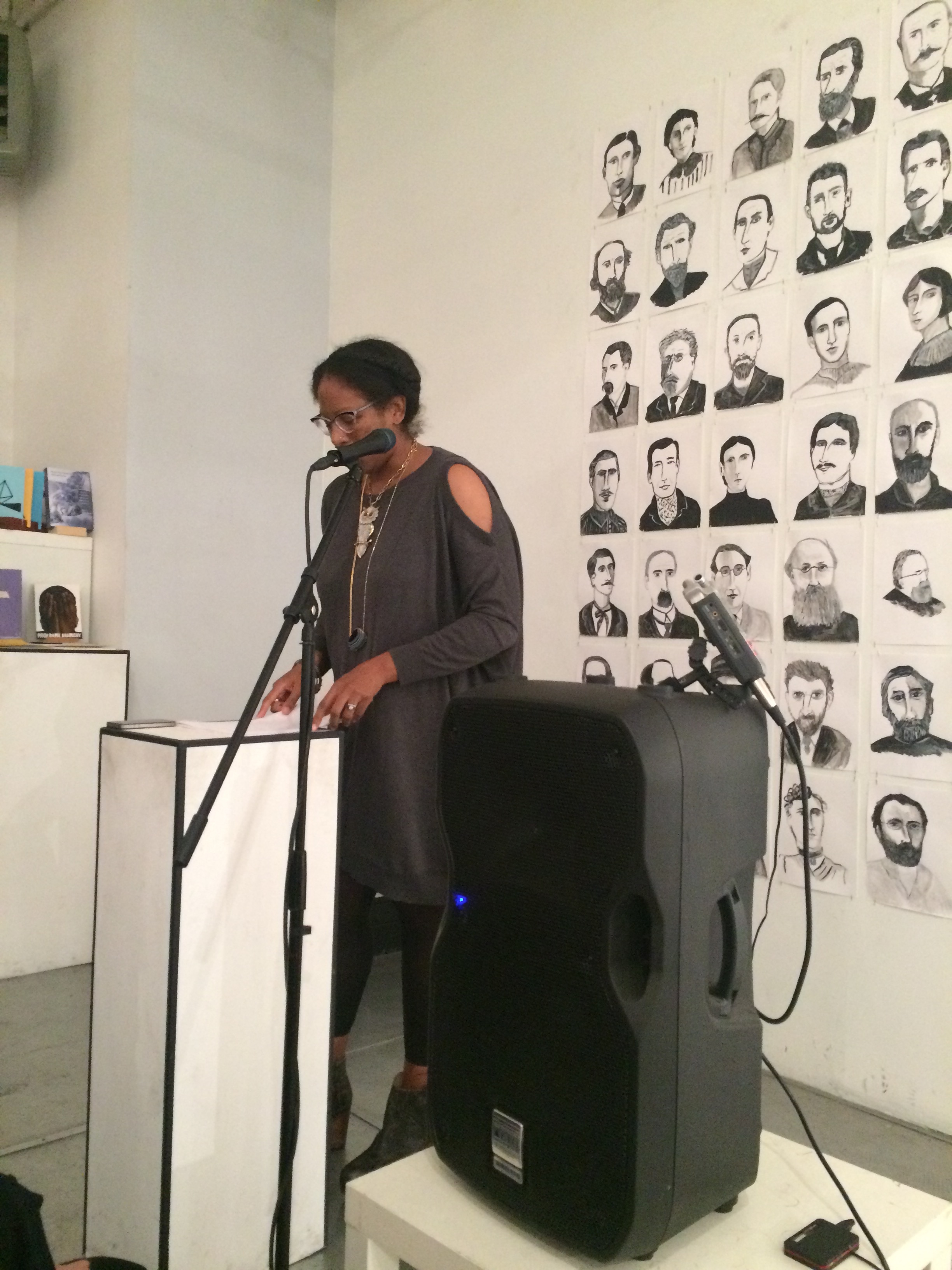
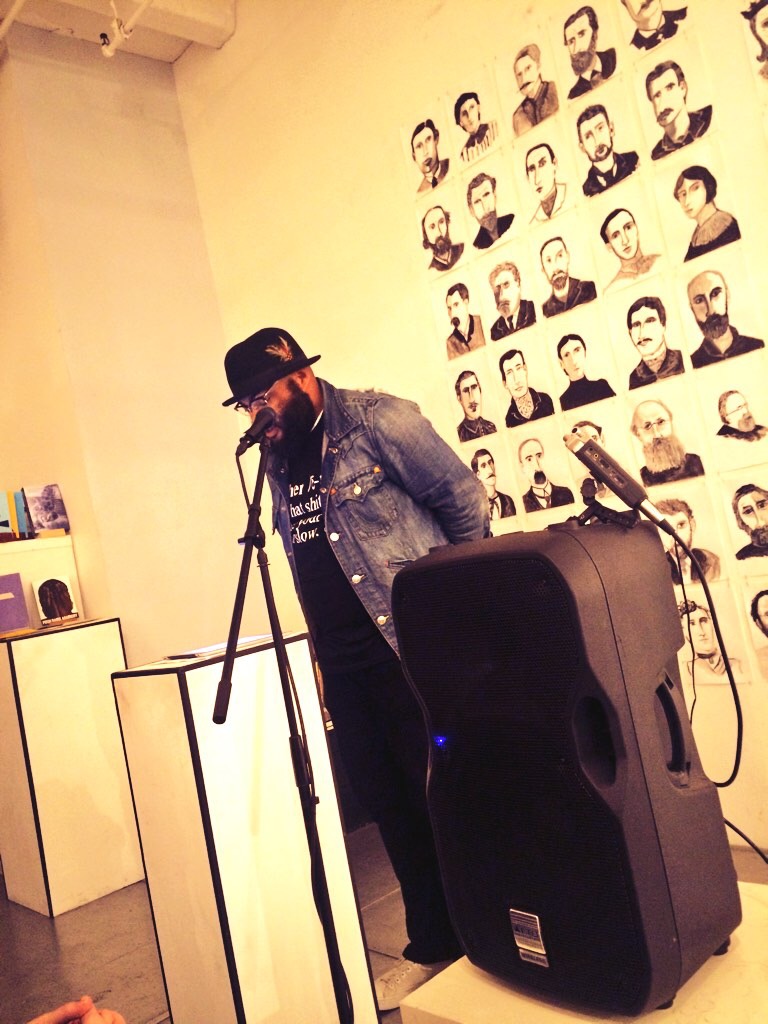
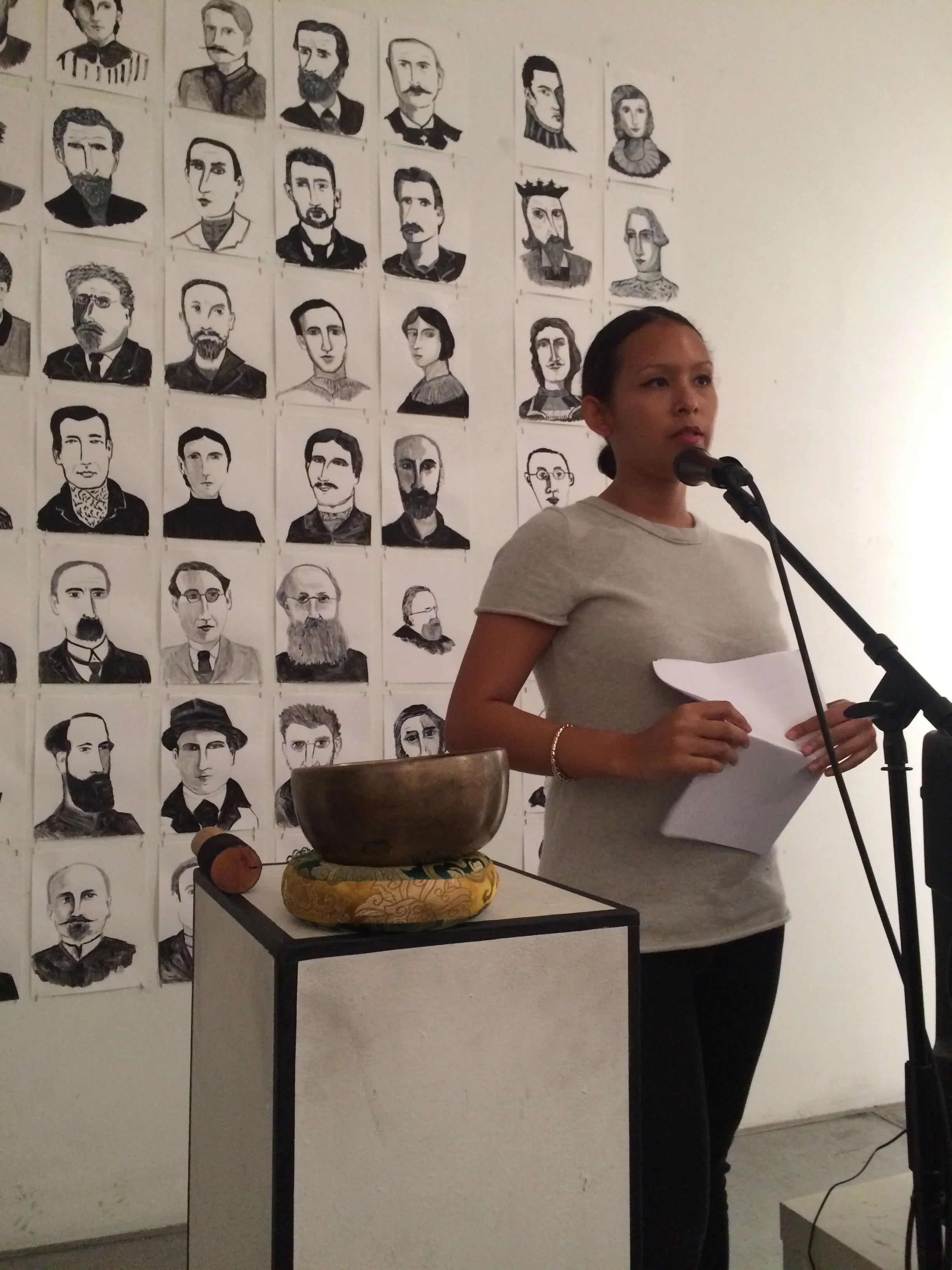
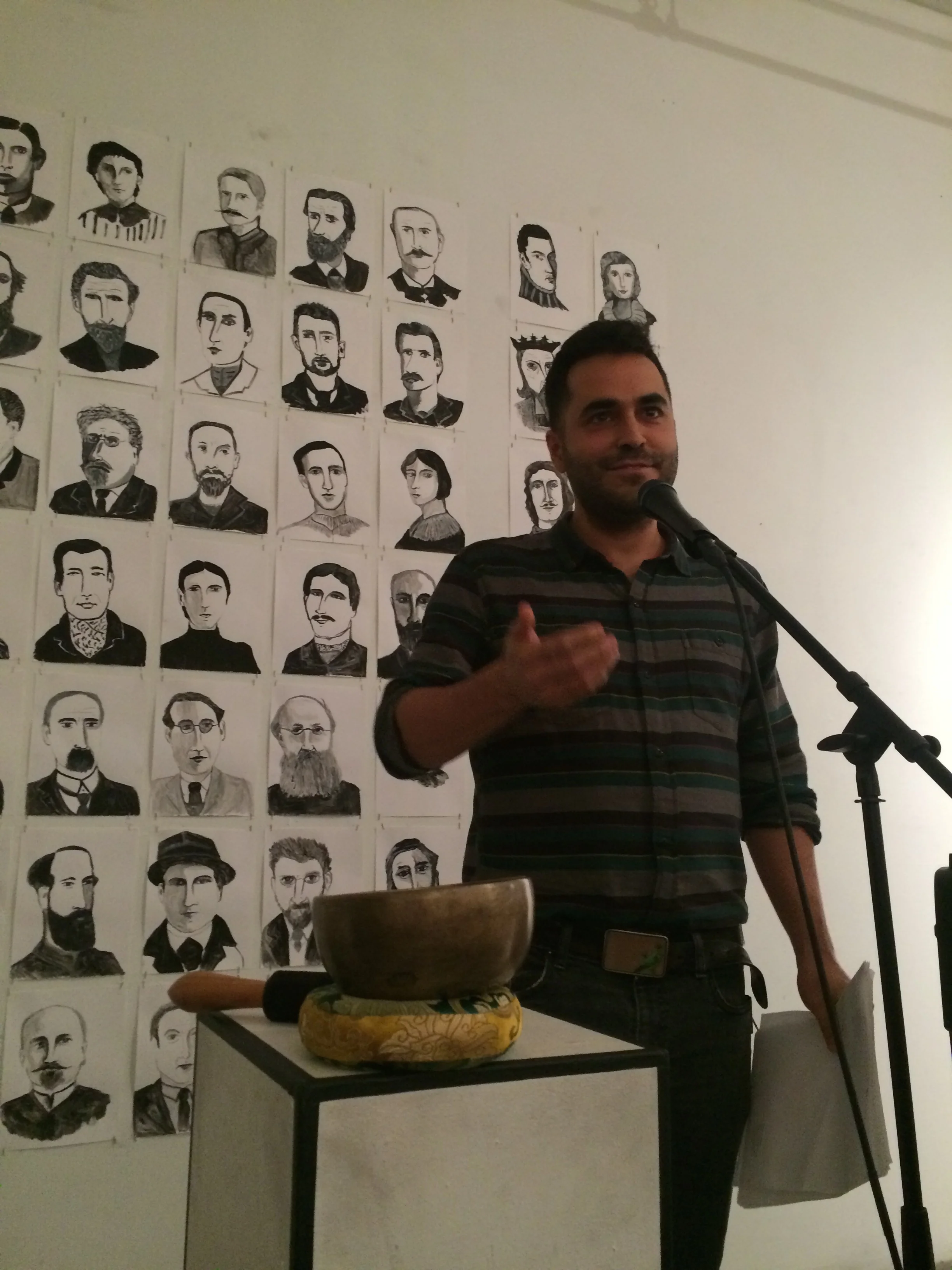
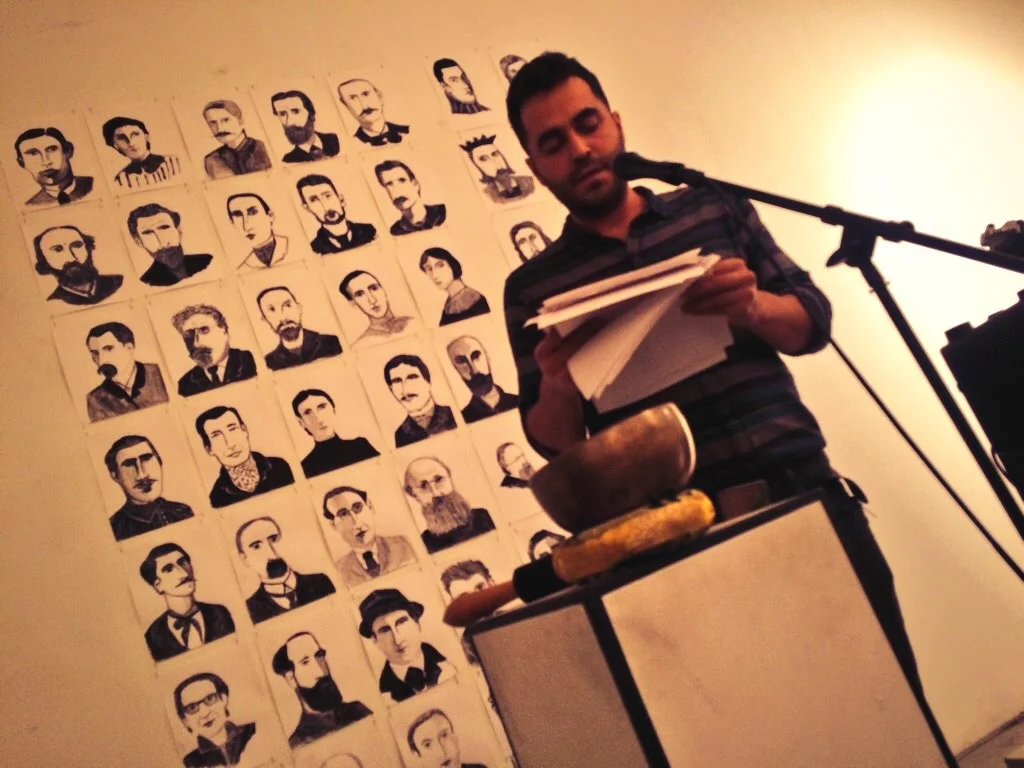
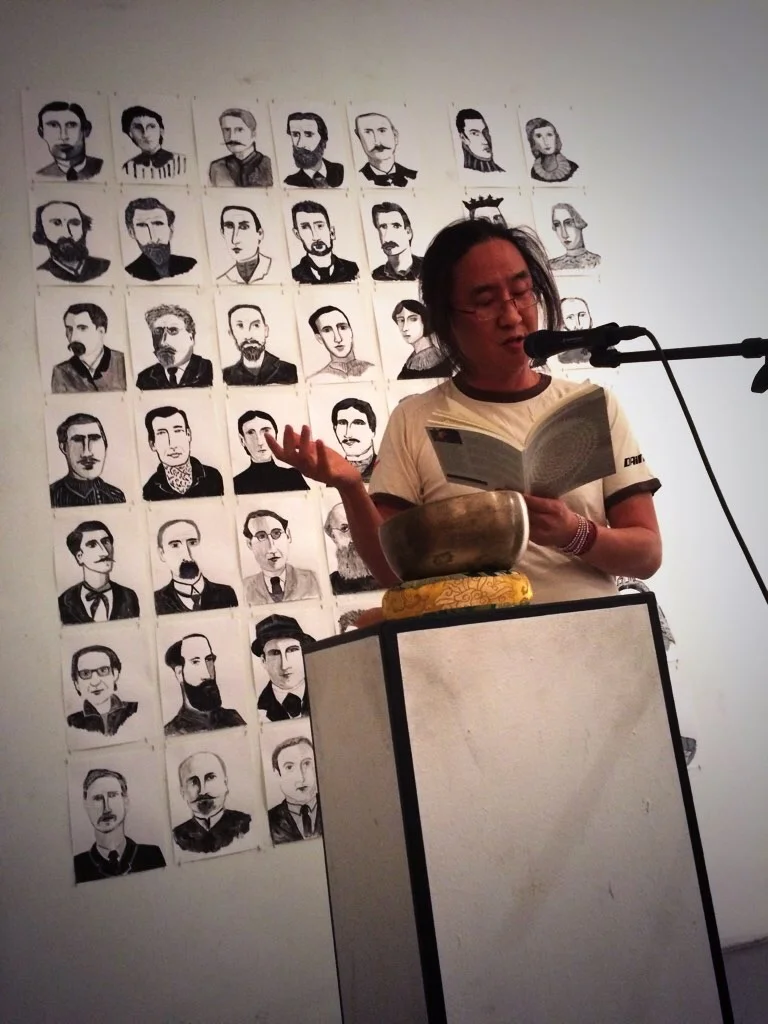
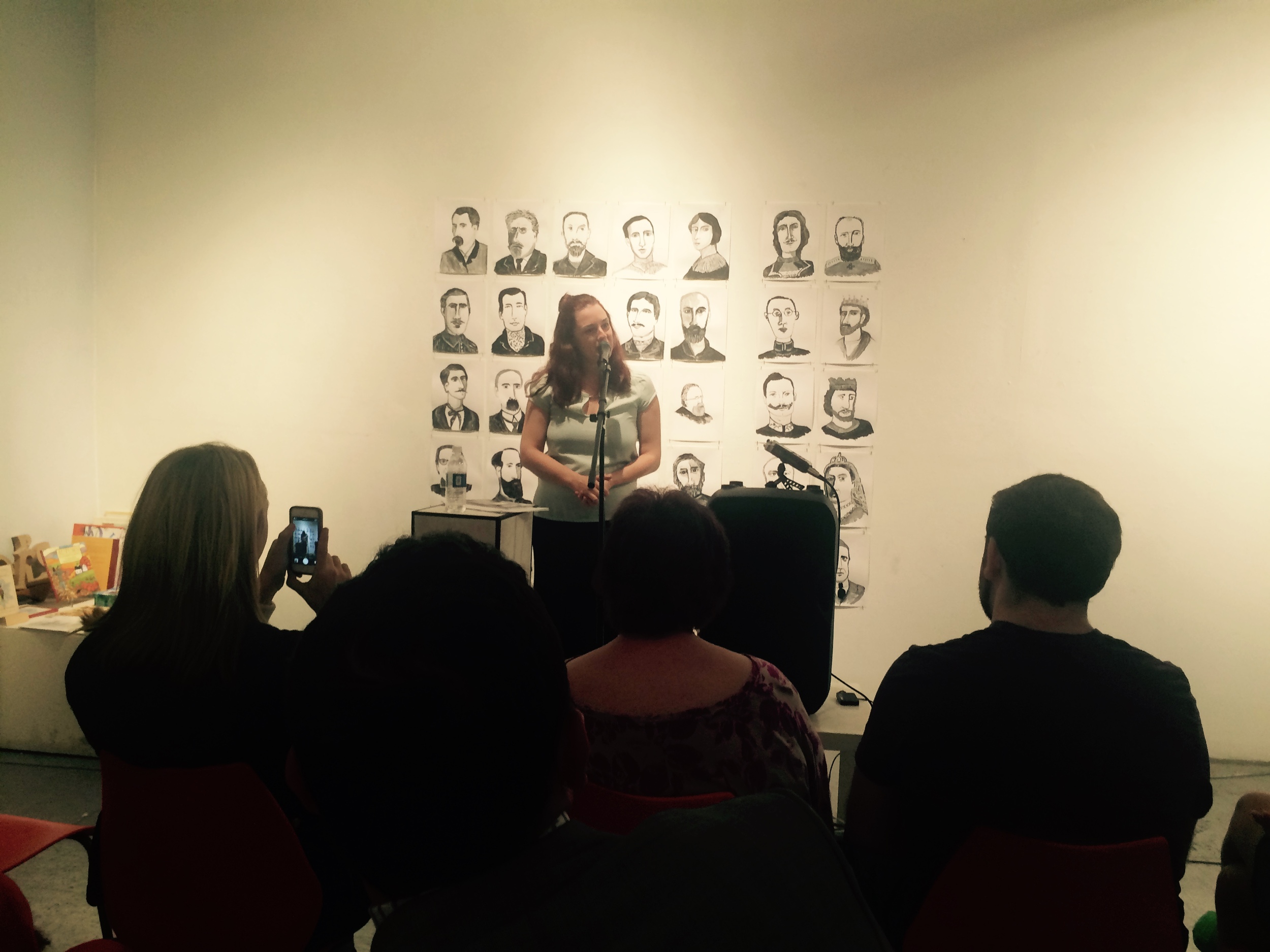
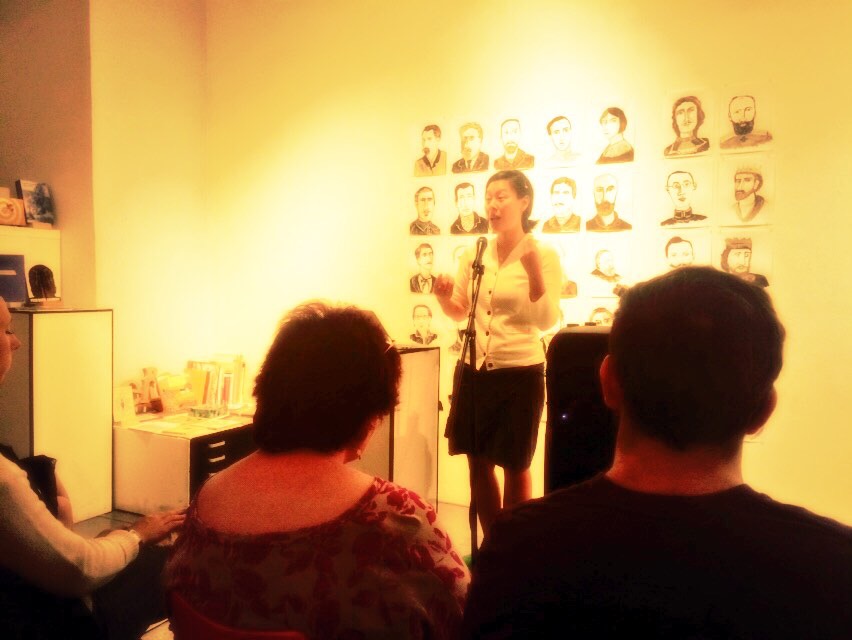
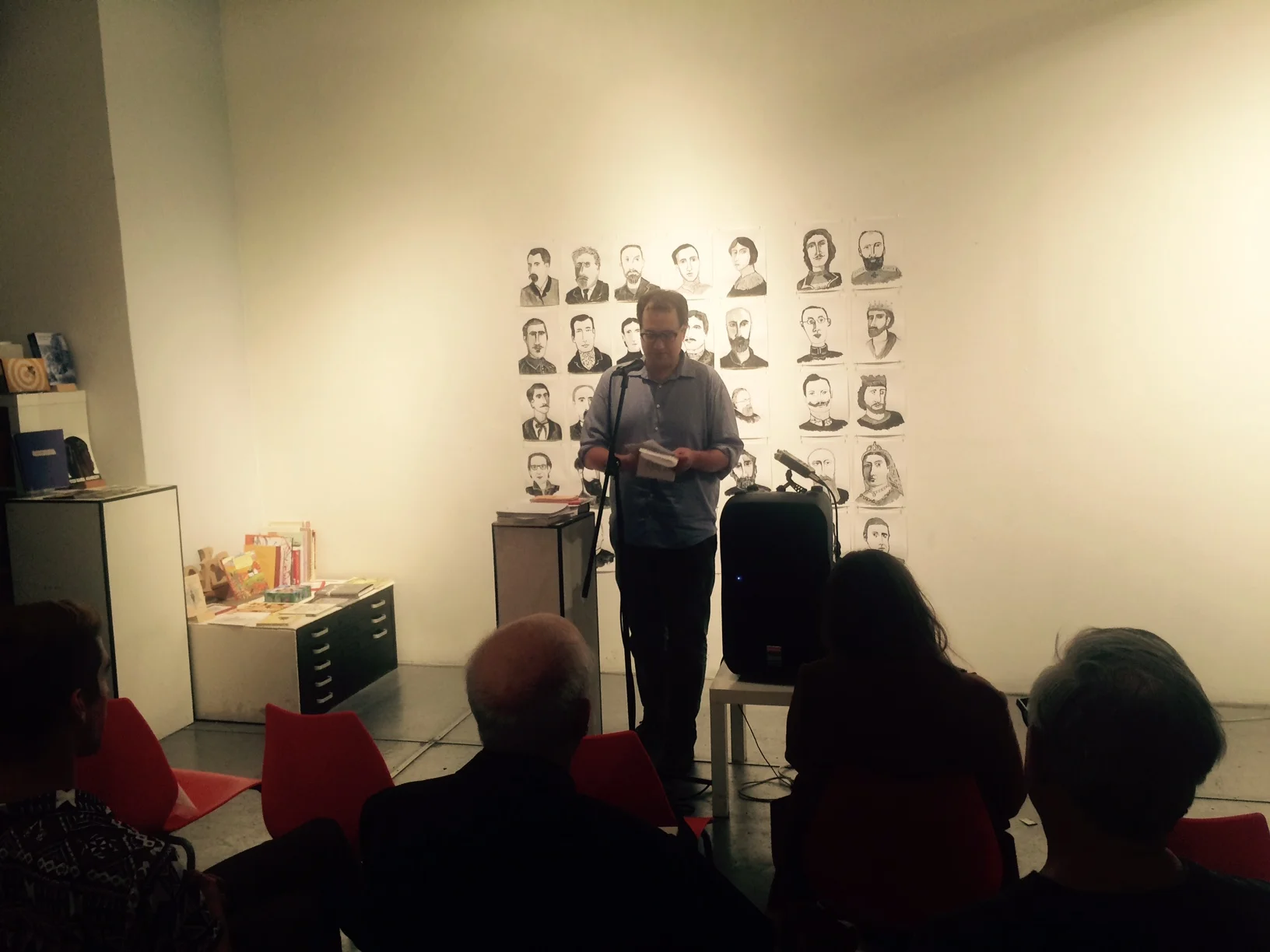
A Reading with Claire Caldwell, Betsy Andrews, erica lewis, and A.H. Jerriod Avant


Here are our introductory notes for the reading, written by Jared, Farrah, and Berl's assistant Samantha Maldonado. The first minutes of Jared's introduction were not recorded on the audio, which begins as Claire takes the stage.


Begin with (first lines of erica lewis's chapbook Excerps from CAMERA OBSCURA:

“a photograph I saw made me think about time and the constant mutability of everything is actually the underlying story of all the stories we write”

 and JERRIOD:

Our nights come gifting
us with burning stars,

sifted by the contours
this language carves

tonight we are hearing poets working on a poetry whose awareness could be said to be not only ecological but Topological. These are poets engaged with the "contours" of language – an environmental syntax, a use of language that could be described as four-dimensional, possessing a sense of space-time that is tactile: elastic, viscous, pulsing with energy.

examples:

Betsy Andrews. SCINTILLATING NOWNESS

“The past and the future are palindrome, think the mermaids, this present is an incessant interruption

Dan Thomas Glass on Erica Lewis “a language that could make the present persist beyond the nanomoments we exist within”

Claire Caldwell “orange time”

 --

Generosity of poets with firewalls up between poetry and their very demanding day jobs (besty – editor of Saveur, Claire, editor of romance novels for Harlequin, Erica as a theater PR person, Jerriod Writer in the Public Schools Fellow and a photographer). Poetry as moonlighting but also as a rare opportunity for access. Leaving a rare window open


Claire:  writing with an interest in different kinds of scales of time:

“whale falls dilapidate forty to sixty kilograms per day during the mobile scavenger phase. A human child may be conceived, born and walking before the skeleton is picked clean.

In Claire’s poetry land is as familial as people

Poetry that drips with nature, that can’t move forward without an aspect of nature,

“a house with snakes in its walls. Nightly rustlings, flickers of milk-green in the pantry

 pressurized, Hothouse vibe

“In the museum even portraits seemed warm-blooded”

“The city swelled like an oyster when it rained”

Poetry of honesty, colorful, compact, quiet yet demanding “I arrive like a drug”

An interview with papirmasse describes her new book as juxtaposing the calamities of climate change and the dangers of the natural world with the intimacies of daily life.

fascinated by the lines we draw, individually and globally, between ourselves and the natural world

My hope is that poetry can connect people with the magic and mystery of their environments in ways other media can’t.


Betsy

I get the feeling of the apocalypse in Betsy’s work but it’s apocalypse rendered as vibrant and magnificent tapestry so when we might feel like we are going under, the energy of the poetry keeps us aloft.

There’s this sense of immanence, of about to happen, and of having happened just an instant ago, like the cartoon coyote going off a cliff and still hovering in midair. 

The sun is coming up, I am turning you over
I am going to be able to see your face

churning sentences that can mimic the flow of traffic or the swell of waves – betsy’s sentences unfurl over a landscape as if endlessly. I was showing my intro notes to Farrah and she said the quotes are so long but in betsy’s case especially it’s difficult not to quote her at length 

FROM NEW JERSEY 

"a bus full of party delegates slouching in their friction-charged skins/ 
rolls past the jobbing line, rolls past the meat-packing plant/
toward the birth of a new convulsive nature, a countrywide husbandry,/ 
an emotional swing, the dream of the dream of the dream of a driver,/ 
seated and commandeering down the gaping streets of retractable housing/
where the aluminum siding licks its own wounds,/ 
and a four-year-old in the driveway/ 
repeats to herself, you're okay, you're okay"/

THE BOTTOM 

she’s been here before the back beyond, this spider crab, this scavenger, bandida of the nets
before the gluing and the ungluing of the wild, wild west
before the butcher, baker, and candlestick maker washed up in their jalopy,
and disembarked their sloppy ark of pigs and sheep and donkeys,
who, having nothing more to eat, ate the island head to feet and burped a pile of gristle—
the monkey flower, bedstraw, lace pod, paintbrush swapped for European thistle;

 the energy of her line is just so impactful and I get the sense even she is just riding a wave- I was struck by the way she introduces her prose poem “notes from the underground” in the journal NARRATIVITY. As a poet, I'm so intensely enamored of craft that the line can become my taskmaster… the messy horde of them resisted the line's enclosure The mob had a mind of its own… it was a choice that made itself.

Farrah was looking at her work and remarked this afternoon Betsy Andrews is a wizard of repetition

“the narwhal the sea cow the sea mink the monk seal a mouthful of ghost word, extinct”

playful with nature, nature as words, nature disappearing before our eyes, ghosting away while we watch, like the turn and churn of syllables that mutates one word into another. (Mink monk mouth…)

it’s easy to keep going while the environmental disasters pile up and nothing’s done about them, as though the more it worsens & the more outrage there is the more hopeless it becomes.

Betsy's writing though is not confined but fierce and uncompromising and expansive “our collective shrug as lethal as a blast pressure wound evidence forgotten as soon as it’s archived”

in this meth lab we know as air

Maybe it’s a bit on the nose but it could be said that Betsy is writing poetry that goes to the depths, to the furthest possible reach.


erica lewis is a poet of memory but it is a peculiar kind of memory that doesn’t seem restricted to the past. She writes “The great hot emptiness ahead what you keep calling memory” and “you are your own ghost” or  – there’s a sense of some time-skipping perspective, like attending one’s own funeral or finding one’s own image blurred onto antique photographs. The  poems often begin with a line of dashes suggesting tuning into a voice already speaking

Her sentences lope back on themselves like little déjà vu dissociations or premonitions or spells:

“to shrug off the urgency we wean ourselves from ourselves”

or

“In my head I am the passenger teller of tall tales everything on the edge of everything

or

“one is one’s own misrecognition / read as an epigraph

“you drive all night to find yourself standing in the road”

“I will hold my own hand”

“I’m bleeding on my own body”

In an interview with ArtAnimal Erica talked about her bk began in a period when she’d quit her job and felt her sense of self in some way stripped down, asking a question “How do you survive when you’ve already disappeared?”

Samuel beckett-y feeling of somehow like gathering this tiny silent particle of void and cloning it to produce a vast text, a hot-air blast of pure sensation, a disembodied voice in a darkness, the warmth inside someone's head.

 Samantha Maldonado said murmur (from the title of her book Murmur in the Inventory) was so apt, that her writing feels unique in its volume, like hearing someone whispering right in your ear, tense and graceful and insistent.

In an interview she said, “A lot of my work has to deal with memory and the past, and how we grapple with the things we cannot change in order to move forward. Maybe I’m just trying to work out some unresolved issues that I have with growing up and being an adult. But I think it’s good to put all that out there; maybe others will get something out of it.”

Erica “we live in a place of corridors” and Jerriod is certainly also interested in hallways as access points to memory.


Jerriod

A friend and supporter of Berl's, his kind words on Brooklyn Poets.

From Longtown MS (between Oxford and Memphis)

In an interviews Jerriod talked about how childhood is inflected with “the traditions and social formations of southern Baptist church discourse

And then how he found a familiar “cultural aesthetics” here in Bed Stuy Brooklyn that resonated with his childhood in Mississippi and elsewhere. What especially strikes me about the work of his poetry is how it engages with questions of cultural aesthetics not only in the content (we certainly get a lush sense in his work of honeysuckle and johnsongrass) but the syntax, the way it plays luxuriantly with pace and tempo.

Jerriod is also a photographer andI was looking at his photographs which were featured in Columbia in which he achieves a unusual, narrow depth of field so there will be a thin layer in extreme almost precariously crisp focus – figures on a street corner for instance - surrounded both in front and behind by a shimmering blur of urban landscape. They are mostly city shots but critic Patrick James Errington aptly likens them to still lifes.

I see a similar kind of intensity in Jerriod’s poetry, which has a intriguing mixture of slowness and intensity. He will write these very long and languid sentences that meander in a sinuous way through clause after clause while describing an activity that is full of energy and directness so there’s this tension between the controlled syntax and the wildness of what is being described.

For instance from his poem “Stealing Seconds"

we wanted what we did. the hang time, the air, the freedom, an opportunity to alter the landscape’s composition

sugar melting in our arteries, leaving this earth on wheels and adrenaline,

I see him playing with tempo in the way he deploys words to create waves and eddies that make his poem nonlinear and pulsating. He writes: 

she was long    just like the word    drawn-out

and another example:

planted engraved swirlings curved permanent at the end of me 

There’s an awareness of space-time in his poems, time inflected by where it is passing, space rendered by time in unstable ways, such as memory.

his poems are interested in time and its own swirling. From a poem that recently appeared in Calaloo entitled UNUSUAL TIGHTROPE

I often ask what is it about hallways
that makes them seem smaller after time. My friends say, it’s the

fact that your ass has grown up and because you’re bigger, the
hallways get smaller. But I know that hallways don’t physically

shrink the same way that grapes give up their smooth skin while
drying in the sun.

In a recent interview about this poem, Jerriod said he wanted “to capture on page what going home now felt. I wanted to recreate that space, its slowness

I’m intrigued by this idea of space has itself having a slowness, and I think Jerriod’s poems flesh out both this idea and also the sense of shifting tempos that exist in language.
Launch reading of Timothy Liu's DON'T GO BACK TO SLEEP (Saturnalia Books) with Rob Ostrom and Vanessa Jimenez Gabb

Here are the notes by Jared with the assistance of Victor Allen toward the introductions for the reading:

VANESSA JIMENEZ GABB:

"williams says love is unworldly and nothing comes of it but love

and nothing

stays in me more than the same person

for more than three thousand days

the treaty of Versailles said yes cut away everything"

Vanessa in an interview on luna luna that her poetry is exploringwho i am in the relationship [with her partner], who i’ve become. The notion of ruin, states of beauty and disrepair that people go through, couples go through, structures go through. If we can actually return somewhere. What about ourselves is lasting. How the personal is political and the political, personal.

All the poets tonight are following this idea- relationships between self and other, personal/political, memory and change.

Vanessa writes: “Be more radical, star, you will say Don’t stand there burning”

---

 ROB OSTROM

Rob is putting the myth in mythopoetry

Lucie Brock-Broido mentions sorcery in her blurb for rob and it seems very apt  “Turnip fields” horses, red bluebirds, birchbark. “an injured sawn”

What do these spells do? They transport.

He mentions joseph cornell boxes in the notes to his book and the comparison is very apt, the effect of framing, the sense of a childlike awe rendered at a slight distance,

“I woke and found a deer in my bedroom”

waking from a dream into a dream.

In dreams where you are all the characters – but these characters are often elemental . “seven horses eating green from their hooves”

“you moved through my body without touching my body”

 this autumnal sort of pastoral dark and magical.

“written on the side of my skull”

TIMOTHY LIU:

Interplay between political and personal history, between the mystery of the past and the tenderness of the present. There is a parallax between history transfigured into gossip (as when in the first poem a horrifiyng atrocity comes up in conversation with the speaker’s hair stylist) but then conversation as mortally serious (the hair stylist dying of throat cancer). Timothy is pulling at the disproportion between these atrocities and the responsibility of the speaker – “What should any of us do while they are alive?” he asks, or describes “surf[ing] the internet all day for atrocities”. There’s an unstable mixture of the careless and the lapidary, living for pleasure and living for history, that weighs the erotic – for instance the sense of how intimacy is inflected with power and submission, how one’s sexuality is this complicated adult trace of one’s childhood, “no one dies in the summertime, he says off the cuff, something I want to be true even if I know winter’s just aroung the corner- a face cord of fragrant wood needing to be stacked even if he won’t ask.”

 Timothy describes the “ghost ring” that remains when a wedding band is removed, and a rubbing that records the text on a monument to “homeless spirits” whose stone has since been lost – and perhaps this sort of second-hand memorial is just what Timothy’s work aims at, an elegy for ghosts.


Kelsey Street Press launches Jasmine Dreame Wagner's RINGS also featuring Kelsey Street Editor Rena Rosenwasser

Here is our introduction for Rena Rosenwasser, delivered by Farrah at the event: 

I was looking up the map of Berkeley out of curiosity this afternoon and found the actual Kelsey Street, an unassuming one block span at the edge of the hills just south of the university campus. Dotted with a mix of evergreens and palm trees and sort of Pacific rim-ish arts and crafts-y houses it seems resonant with the press, which out of generosity and will and invention has created and continues to create its own axis as a platform for diverse women writers and is especially strong in supporting a kind of trans-national work that crosses or perhaps explodes boundaries. Writers such as Cecilia Vicuña, bhanu kapil, etel adnan, mei-mei bersenbrugge, Barbara guest… etc.

In a sense (I’m reaching slightly) there’s maybe a Californian utopian sensibility of the press but at the same time Rena, as founder/editor, grew up in NY and I see that urban heritage at play in her book ELEVATORS. (The elevator and the skyscraper are much in the mix here and it’s so nice to welcome her to NY’s only poetry bookstore for this reading!)

ELEVATORS is a traveler’s book, full of Italian cities, Paris, Prague, Budapest, Egypt, and this cosmopolitan-ness seems to climax in the title poem by thinking on the elevator. Elevators suggest transcendental aims and the book certainly speaks to this, though it often seems that the elevators of the book take the reader not to some office space in the sky but to connect people. She writes “turning Eiffel’s bridge vertical”. It makes me think of Philippe Petit’s wild tightrope walk between the world trade center towers and in a sense this is the work of the poet and of the editor, this act of belief of imagining a community into existence. Rena writes in this vein about how the grid of Manhattan began as “pure potential” – and this mapping was a “most courageous act of prediction” framing unimagined buildings and existent activity.

Rena’s biographical note describes her as “traveling extensively as she supports and collects the work of contemporary women artists” and perhaps it’s her own travels that inform these lines from the second long poem in ELEVATORS:

“words transgress. Depart from their usual fittings. If I nudge them they might travel anywhere.

I think here Rena is drawing an analogy between a life celebrating travel and the work of poetry to set words moving, to send them on a journey. The etymology of the word ‘transgression’ has to do literally with stepping across and this celebration of crossing borders or rendering borders obsolete is surely the innovative spirit behind Kelsey Street and behind Rena’s work. We’re so happy to have her here at Berl’s.


A Reading featuring Melissa Buckheit and Sueyeun Juliette Lee

Here are Jared and Farrah's notes towards the introduction for the reading delivered by Jared:

I was just reading Melissa’s line “Any jar is an open sea” as Farrah at home with our son Roman, emailed me some notes on Juliette’s work in which she referenced Gerald Stern’s idea that a “lyric poet is one with a broken jar inside her,” saying that she couldn’t help thinking about the broken jar while reading Juliette’s work, how it searches, asking questions that aren’t or maybe can’t be answered. Farrah and I are have a baby due January so maybe that gave me a different angle on Gerald Stern’s broken jar, as if it isn’t an internal hemorrhage but a pregnancy – and this felt a great place to begin while introducing these two poets we’re so glad to have with us here in NY tonight, on the body as a site of both wound and possibility. That jar of open sea that Melissa writes about, or in an analogous moment in Sueyeun Juliette Lee’s poem “The Benefits of Having a Human Body:” most places I go to have disappeared. They do so all the time.  I traveled in a ship at great speed across the sky. It was cavernous and dry. I was on my knees. Tell me about the things you also have ever seen. Were they bordered on three sides by the sea.

Phila, Tucson, Traveling, multicity tour… 

Sueyeun Juliette Lee

Very glad that Juliette is reading here at Berl’s. Juliette’s a very talented book artist and a great reader and editor and I envision her as a reader being this sort of ethical hub, improving our conversation about poetry. found her recent essay on conceptualism, race, stupefied sublime, as just one example, eye opening and persuasive, full of totally invaluable insight and empathy. In our winding path to opening this bookstore, one of the crucial experiences was in helping our friends make chapbooks by hand and grasping how books like the ones we sell here could be appreciated as the physical remains of a living community. In a sort of maybe-apocryphal oral history sense I think that Juliette’s books inspired and taught the makers of other stab bound chapbooks so that I think we learned from students of her students. It makes me think of reading about how Philip Glass was the student of the student of the student of Beethoven. Lineages that hopefully mean that a community is growing and thriving. Her work publishing hand-sewn chapbooks at Corollary Press to create an explicit platform for multi-ethnic poets is a significant contribution. 

Farrah and I were reading Juliette’s poetry today and we were struck by its quality of being multi-layered and elegiac in an unusual combination, because of the way she deploys different techniques including appropriation so her poems have a complex variety of textures that makes them full of surprise and mystery.  Farrah said she is like four poets wrapped in one, which is perhaps one of the benefits of being a good editor, that others change the way you write. A poem of Juliette’s can veer very quickly from mystery to clarity, aphorism to observation, jadedness to awe. Here’s an example:

“We share a few things: your music is cheap and steady, which is understandably timeless. Worried by the lack of dimes, chasing the slot not tasting like peppers or ginseng. When tea makes the eyes water consider it ready, race to chalk lines for tennis. The human body is a marvel and I move faster for my hairlessness. This is suddenly mysterious and you are strummed. The night regains itself later before the outbreak of one hundred falling stars. We sense that miraculous as it is, this has happened before.”

There’s a quality of the apocalyptic here but the frame so tight on details like the peppers that this apocalypse only appears as a shadow, an immanence.

“The world begins its steady countdown. Closeup of his clenched fist. 

I think the “closeup” is a key to reading Juliette’ writing: often she takes on this bewilderingly rapid journey from zoomed out macro politics to somewhere up close to a body. “The ‘nation’ as a furtive heterogeneity we want to read as flat // And it casts back an arbitrary stasis of “THEN” that this body (suddenly) enfolds”

Thus, as Farrah put it, Juliette’s poetry itches toward a loss “you erased the word home inside of you” in a way that is socioculturally observant and biting. I wrote down in my notes “punk stoicism” while reading lines of hers like “Hyeah! An angelic chop!”

Here are a couple excerpts from her poem called “dear Margaret Cho” – the universe in Juliette’s poem is tellingly in scare quotes:

“standing on a stage everything is comic, meaning small and memorable, or the insubstantial ‘universe’ a minor disaster or floating chord." 

The way Melissa works a word like pelagic, Juliette does with “paene insula” (Peninsula means almost island but we get a lot of the pain as well.) She writes: “Paene insula. Of almosts. Paene, suffering what constitutionally reemerges, suffering predicated on absence [sensations]. If I could see all the way through to the horizon, maybe. Paene of distances, paene of nearsight. Paene of oceanic abundance, which we like to say was renamed ____: to mark or brand.”

Whether conceptual collage or elusive lyric argument or address, Juliette’s writing weighs and balances readership and writing through memory.

In her recent chapbook A PRIMARY MOTHER she writes “Add light to light and you have darkness. Add light to light and you have expanse. Add light to light and you have memory. Add light to light and you have light. 

In her poems it’s as though everything is floating and everything is waiting to get snatched up from within her. As readers we get this movement from history and politics (war, partition of Korea) to the body both on micro and macro levels in Juliette’s work. She’ll be quoting the Korean Central News Agency commenting on the white house press office in poetry haunted by war and language and then ten pages later the book touches down “It is beautiful to be made a human, a human with eyes that see, ears that hear, hands that clasp things close to a ribbed chest, within which nests a sleeping cat or a remark on white birch trees along a hill. Beautiful to suffer injuries, to see blood ooze from a minor wound or scrape, how the skin, a softened paper, pulls away in a moist mass…. It is beautiful to wash an open wound.”

I’ll end with another quote from A PRIMARY MOTHER: “Slowly, the body reconvenes. Each pore an aperture, each thread a sieve.”

---

Last night, David Brazil gave a talk and reading here and mentioned Josephine Miles’s dichotomy of phrasal vs clausal poets, so I was thinking about that while reading Juliette and Melissa’s work today. It’s one of those distinctions that sounds perceptive while not holding that much water and requiring a lot of squinting and shoehorning. Juliette may be a bit of a clausal poet but I don’t think it sheds that much light to say so. Reading Melissa today, on the other hand, I actually found it really helped me to think about that idea of the phrasal poet and to zoom in, focusing on the way she uses phrases like a painter with brushstrokes. Her artistry seems rooted in the spaces between words, she is a poet of the comma.

“what origin begin with hair, the tenderest movement out, ends with bodies lining graves, an inability to pronounce the phonemes of your now foreign language. The language itself, an answer”

Amplifying this effect of lulling parataxis if the way she lays her poems out, so the often the words are strewn across the page like flecks drifting in a fluid.

“kelp-forests and / olive-green limpets, petrel, pelagic  atoll, lipstick   pixie, fairy puke-  night aquifer”

you have to consult the notes – really more like a glossary, full of definitions of etymologically hefty terms like epiphyte and perilune and NOCTILUCENT (title of her recent book from Shearsman), vocabulary from the natural sciences, astronomy, Latin, Greek – to find that lipstick pixie and fairy puke are mosses from the Pacific northwest rainforest. This is emblematic of the experience of reading Melissa’s poetry, which seems built primarily out of a mixture of awe and calm. There’s a sense that part of her joy in writing poetry is to get the chance to dust these words off and take them out for a spin

Melissa is the second poet to read here at Berl’s this week who had the word “pelagic” in a poem (Seth Landman last Wednesday offered“pelagic silence”). Pelagic – though linked to the more normal word archipelago - seems pretty uncommon, kind of a loud, showy word that seems to emphasize “you’re reading this word in a poem. A poet is speaking.”

On one page “Pelagic shell adored, unadorned” and then the next the thought line continues: “Cool air, it’s pleasurable. Please from pelagos. Related word, placate—Any jar is an open sea.”

I admire how Melissa here is unpacking “pelagic” as a way of making similarly uncommon and loud and fresh and poem-y a whole constellation of normal words like placate and even the simple “please” (I have an almost two year old so I think a lot about the word “please” which my son pronounces “piz”.). Melissa makes me feel a little of this exciting estrangement from language, relocating the calm, navigable sea behind the idea of soothing pleasure.

Whether erotic or scientific There is something oceanic about her poetry, its lyrical measured flow; I found its pace leisurely and wave-like, forming small-eddies. Bodies in her poem are watery and feel marine.

“jelly like   the pelvis appears   among deep –sea vent”

“to deliver   a slick baby through the salted fluid”

“a bottle of seawater  wrapped in a skirt smelling of her body”

When I stayed in Tucson we ended up at the home of a filmmaker who had constructed a grotto in his desert-y backyard surrounded by tall grass with deck chairs facing a large colorful photograph on sun-resistant truck siding like a personal billboard depicting dunes on a beach. I thought of this sensuous optical illusion of the ocean hundreds of miles inland when I was reading Melissa’s work. She reminds how we carry the ocean inside us.