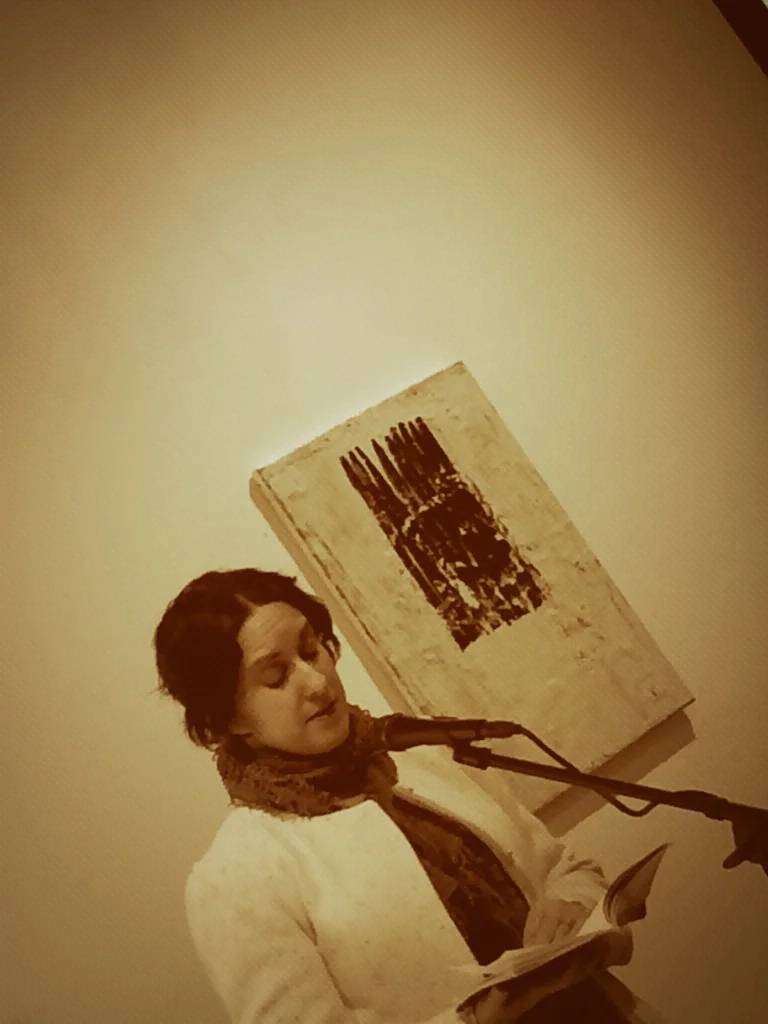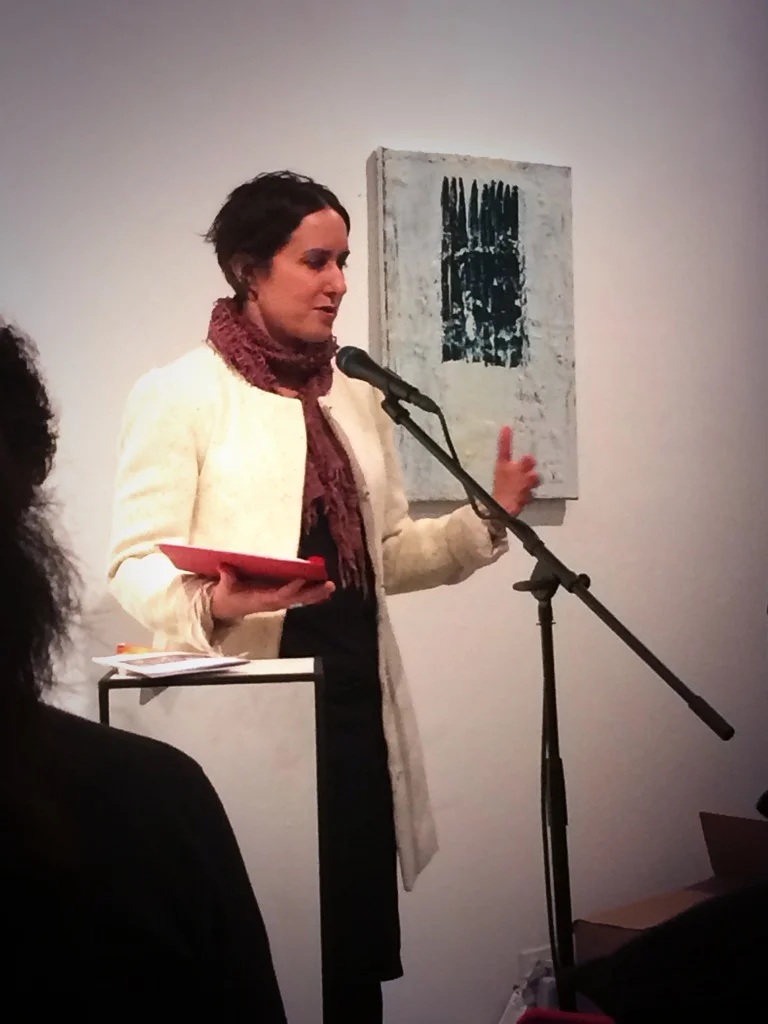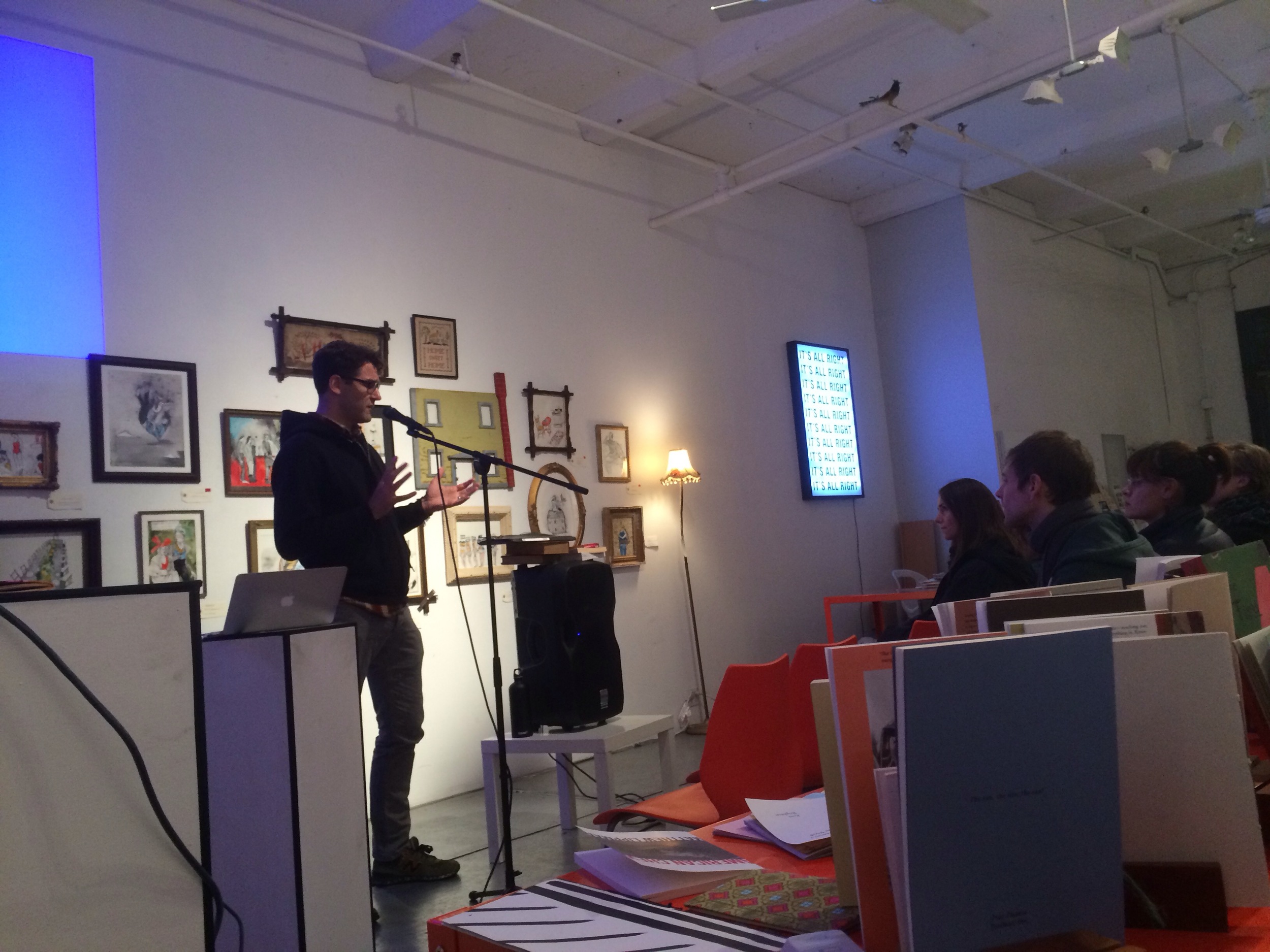
Anne Shaw, Joseph Fasano and Sarah V. Schweig

introductory notes by Jared:

Tonight we have three poets virtuosos of the indented line. a poetic cross stich that suggests meandering thought,  magic, incantation, artifice: gravity and the deformations it produces the way the moon causes the tides. The accompaniment of tonight’s reading might be viola: dark, poised, more weighty than the violin.  A viola concerto then: these are poets whose work is clean, immaculate even, locating emotional power in discretion, as if the poem were a threnody for the words left unsaid.

The vocabulary and even the punctuation (lots of colons, m-dashes, commas) in Anne Shaw’s poems have a gilded, baroque quality, a careful, worked-over beauty that becomes even more intense when describing ugly and painful things.

How to carry. Heave
and heave. How to stitch the breath. 
Where wallets and torn flip-flops clot the beach 

as each day’s crushed trucks wash in on the tide. 
Shoeleather burns on the trash-heap 
and another acrid smell

of diesel fuel and rubber, sour fruit…”

Anne’s poems luxuriate in flowing sentences and then suddenly pivot into stutters, sentence fragments like the word “Barnacled” all by itself, or shifting into italics. Yet there’s always an italicized quality to her work, and Shaw’s poems make me wonder what would happen if you could italicize words that were already in italics.

Joseph Fasano’s poems pose questions and then answer them. His poems remind me of someone laying out a series of still, black-and-white images one by one and placing them on the table. This photographic quality is doubly evocative of rituals. The offering of the photographs (or images) deployed one by one is ritualistic, in that its persistent quality could be taken as serene or relentless, inexorable. Then, there is also what is depicted in them and the way photography, or poetry – sentences, couplets, etc. --, aestheticizes what it has captured and makes something that has vanished into a ghost, a trace, a totem. Haunted by tutelary gods, Joseph's poems take on the voices of ghosts that reside in bodies and objects, which gives his work a feeling of gravity and purpose.

A poem online:

 “Moon-
stone, strong-
            box, psalter”

Sarah Schweig’s poems give the feeling of disclosing a secret while at the same time remaining private give her poems a coiled quality, caught in the tension between “telling you everything and holding back. Her chapbook for instance offers a titular central character “S.” who shares the initial two times with Sarah herself but remains like a character in a roman-a-clef disguised by an abbreviation. S moves through recognizable spaces but also becomes a cypher:

“The sign for infinity seems an 8
tipped over, or two S’s
intertwined, figures on their sides.”

I am reminded me of when the movie shoot took place in Berl’s and, filming a book party scene, inexplicably kept filling the room with fog from a fog machine in order to achieve a certain cinematographic effect. “It won’t look like fog in the film,” a crew member told me. Sarah’s poems are like this: pellucid, fragmentary, lyrical, dreamlike even when not describing actual dreamstates, so that the quotidian and the real spaces of the city feel fogged with a sense of irreality, like the fog that is giving an aura to the images even if it is not directly visible
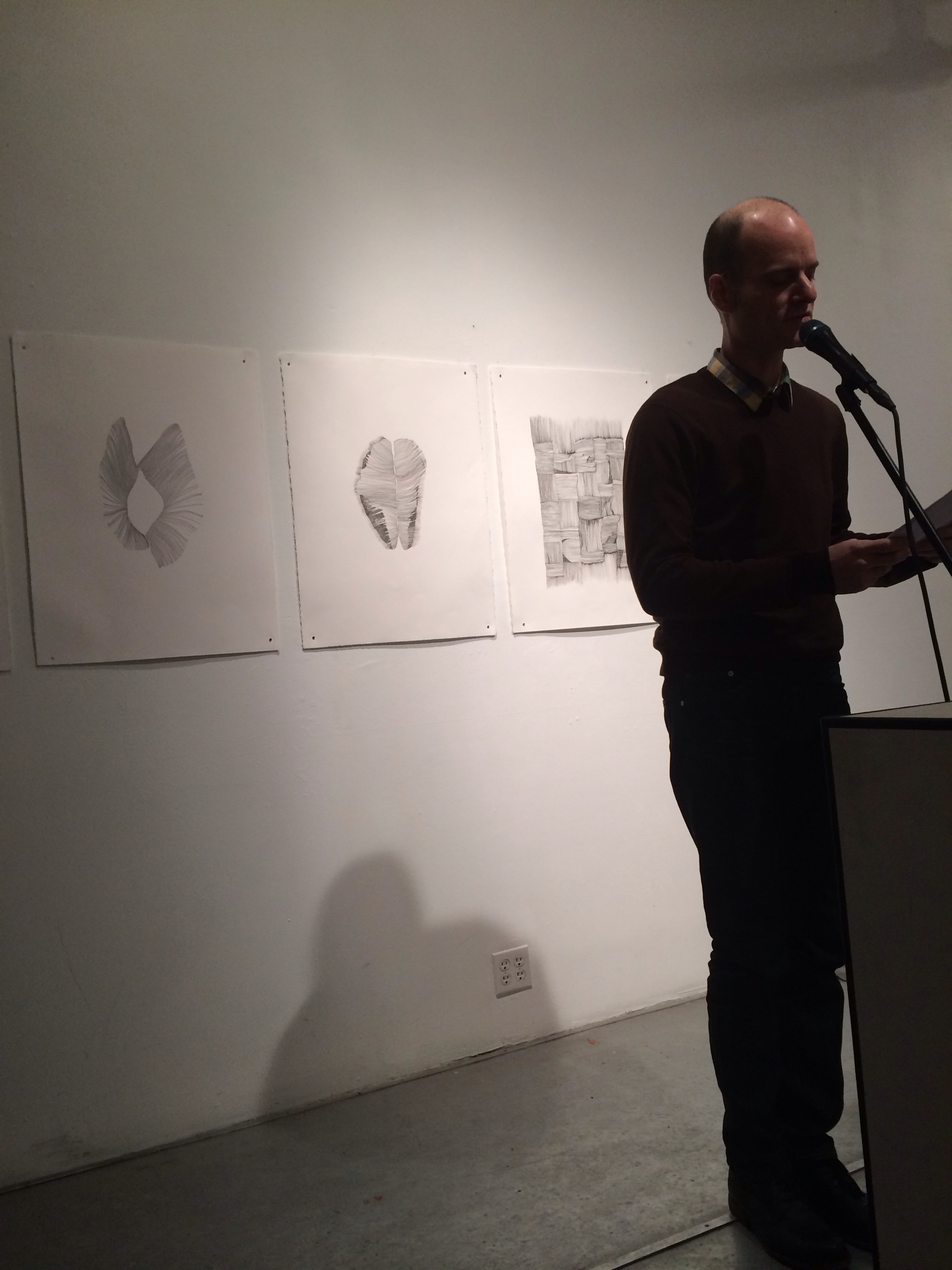
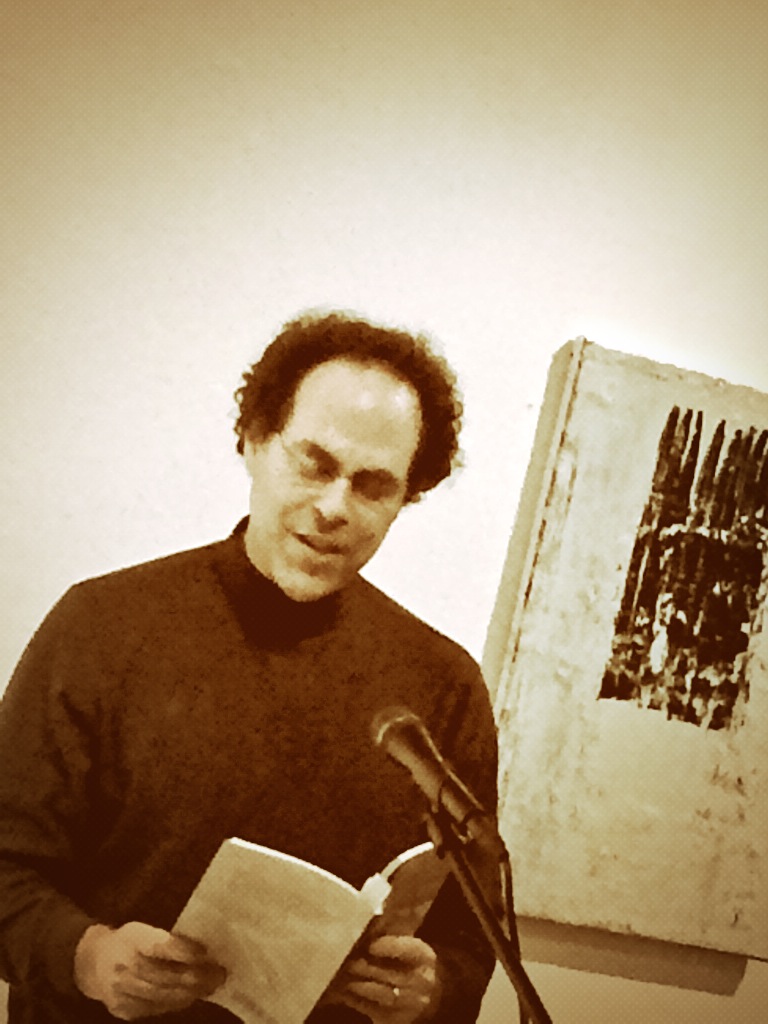
Dan Machlin and Jeremy Sigler

Introductory notes by Jared:

Today we’re hearing from two writers of elegant poetry , aof elegant obsessiveness. Using form as a kind of stylemarker. I might describe them jokingly in an opposition – Dan M as horizontal, Jeremy sigler as vertical poet. This is partly a matter of forms they’ve adopted in work of theirs I’ve read  – Machlin’s intense investigation of a blocky 6 line, 7 syllable stanzas., Sigler’s of a kind of post -Creeley linear mode of stacking single or two-or-three word lines., ending up with something resembling reading Japanese. But we could think of the horizontal as a kind of traversing of a landscape and the vertical as a kind of  cutting through planes. Both vectors connect ideas and people. So we have a certain contrast here, but both poets are clearly equally interested in producing a poetry that is dense and playful and intricate.

Machlin’s work has a Sinuous, sensual languid quality but is also shrewd, unsentimental, down-to-earth. The effect for me seems somehow European in a slightly surreal, de Chirico way. Farrah suggested his poems have a way making a direct connection w language, that the text could  itself have a body

Machlin writes “that the body at times can be thought to overwrite the purity of consciousness”

Lines like this have a way of turning indirect address into a kind of anthem

In ANTEBODIES, the extended exploration of the 6x7 form becomes another way into this issue of embodying. With almost oulipian obsessiveness the stanza structure repeats over and over, creating an armature for many digressive gestures. There’s a sameness and at the same time a sense of total uncertainty, form as a mystery to be solved.

"I can't explain why structure is good for man but it is"

It brings to my mind Kenneth Koch, both the impish dramatist harnessing fragments that seem absurdly non-viable but also the warm teacher -DM 's poems admirably teach us how to read them

"It's not really important whether poetry is red or blue -I do it for fun. Or because it doesn't hurt. Or really because I'm scared about nothing being done." 

So if we have Machlin as the St Augustine of tonight’s reading, offering the poetic body as a building and a civitas (I’ve barely mentioned his heroic work as a publisher with his extremely terrific press Futurepoem), then I guess Jeremy sigler can be tonight’s Thomas Aquinas, as his poems have a way playing with some mysterious admixture of reason and revelation in the way they continuously court an aura of aphorism without ever becoming simplistically epigrammatic. This is partly due to Sigler’s extended play with homophones and deep alliterations, creating word combination that sound logical and inevitable in a quizzical way. “Potion of my patience” he writes, “or “lunar logic,” “garish garnish” “rush into the bush with me blush with me” “Implodes with what I imply”… These torqued mixes of off-rhymes and vowel shifts induce a kind of syncopation in his poems not of rhythm but of phoneme. His stanzas become vaudeville stage in which the love of words becomes a romance and a comedy, both screwball and slapstick. (Farrah suggested that it brought to her mind French Farce- her words were “Crackpot poet is the noises off of poetry!”) If it’s frequently funny though, the stakes in Sigler’s poems are high. “There’s a world awhirl within” he writes at one point, and, in a memorable disruption of the pathetic fallacy “my feelings hurt”

We’re hugely proud to present two great forces for good in poetry today. Dan Machlin and Jeremy Sigler.


Michael Ruby and Jennifer Firestone

introductory notes from Jared:

Tonight we welcome Michael Ruby and Jennifer Firestone. We could call tonight’s reading the “Brooklynite-poets-who-are-parents-of-twins-and-who-are-in-the-Dusie-Kollectiv” reading.
These are two deceptively oracular poets of the now family who use private language to create opacities and distortion effects in poems driven by lines & vivid moments.

Michael is the author of 5 books from publishers such as blazeVOX and Ugly Duckling Press. Two Dusie chapbooks and is also the invaluable editor of Bernadette Mayer’s HUNGER JOURNALS. 
Jennifer has published two books with Shearsman.

Michael: a poet of intensity, energy in letters, syllables, words. His poems have a uncommon density as if written on a planet w more gravity than earth. They conjure—in a good way—magnetic poetry on refrigerators: words as sticky objects that attract/repel. They are tricky, using madlibsy and conceptual strategies but toward personal ends, such as drafting a list of memories. This list is not like Joe Brainard’s I REMEMBER, though, not driven by quip or wit primarily, but instead something is stripped down, evoking the poignancy of simply being a person, a container of situations mostly fleeting and largely mediated through a secret language. The self as a surrealist archive. His newest AMERICAN SONGBOOK follows this logic further, applying not subtraction (stripping away) but addition (the musician’s riff) to turn memorable pop songs into mutations, like language crystals or fungi growing over something familiar. By extending each line of a song in a surprising, oddball direction and then snapping back to the received lyrics after each line break, these poems foreground the lineated quality of songs. Maybe more aspects of life--memories, sounds, the imagination- take the shape of poems, (lines, fields, phrases) than we regularly notice or know. Perhaps experience is structured like a poem.

Like Ruby, Firestone's work seeks to square the circle of a pathetic fallacy of a poem that has feelings, emotions not just evoked by sentences but somehow Inhere in the words. . "Sadness sits on curves of letters" being Human in the post human context. Michael has written about his creative process in a psychoanalytic, jack spicer-ish way as voices from some inscrutable source beyond - instead of Martian broadcasts and the poet as radio, Jennifer's poems make me think of David Cronenberg and movies like Videodrome, bodies turning into televisions. These poems possess the photographic quality of the fisheye, where distortion blurs the perimeter even as the center snaps into focus. The speaking Pronoun “I” in her poems sometimes transmutes into a vaguely unstable “we” that reminds me of the "they" in Gertrude Stein’s STANZAS IN MEDITATION, the self as horde. In her new book she deploys also "others" a sense that beyond every “they” is another deeper “they”. A ambient quality of menace, as in her line: "Others detect red pink shadows. Others flipped open saw shrunken screen"

Leslie Flint Presents A Night with Christian Hawkey

Our iPhone recording failed mid-reading but here is the first ten minutes or so of Christian Hawkey's amazing discussion and reading of his work in progress toward an opera on the subject of Milli Vanilli that later premiered in winter/spring 2014. Rachel Levitsky hosted the evening on behalf of series host Joseph Bradshaw.