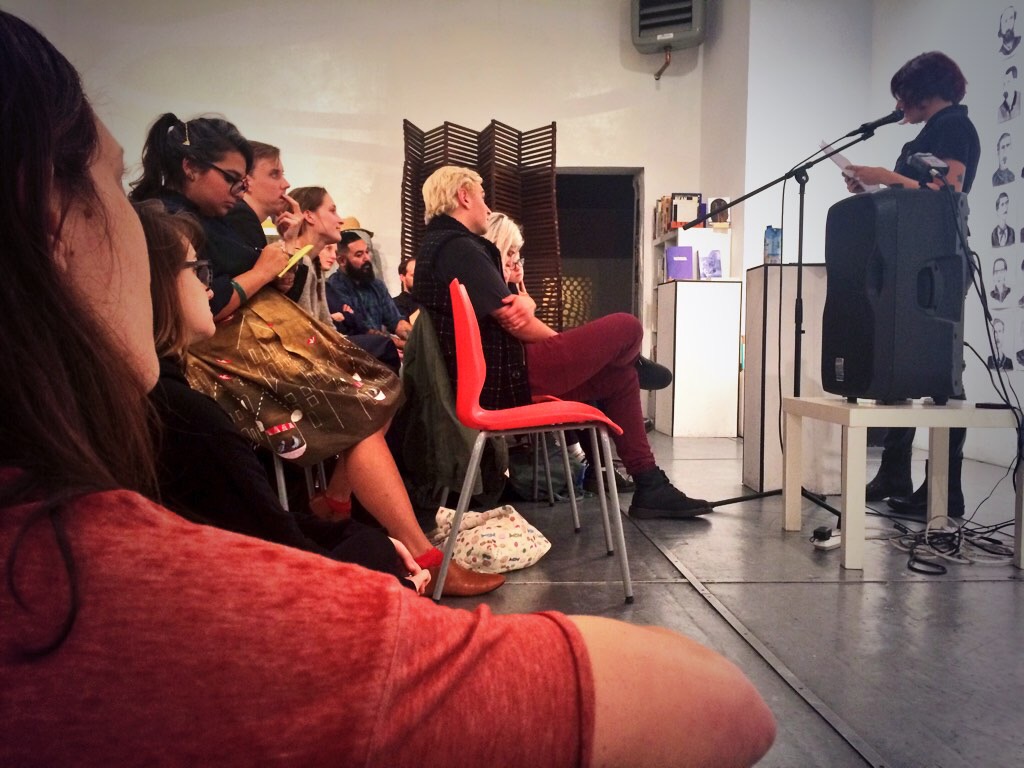
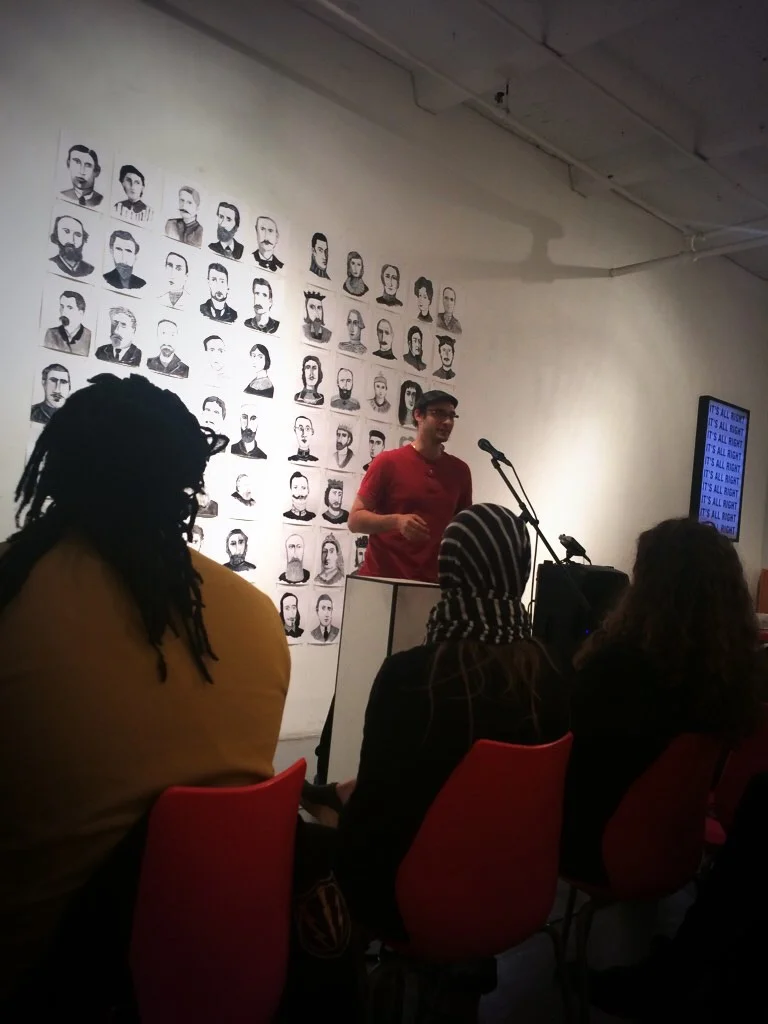
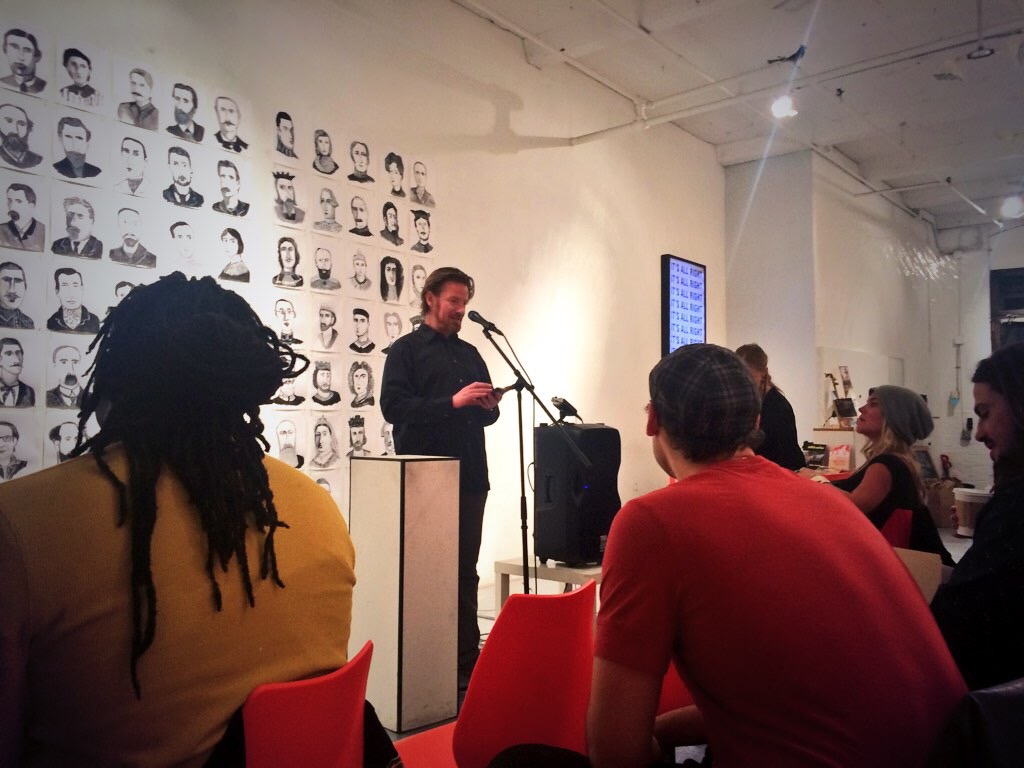
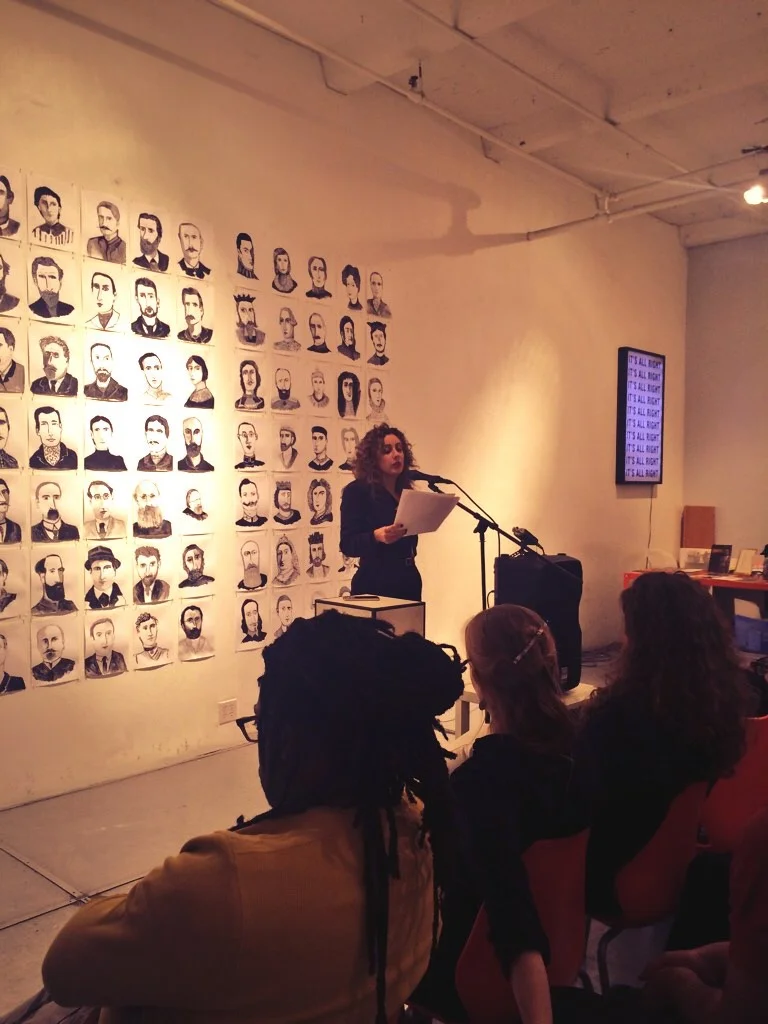
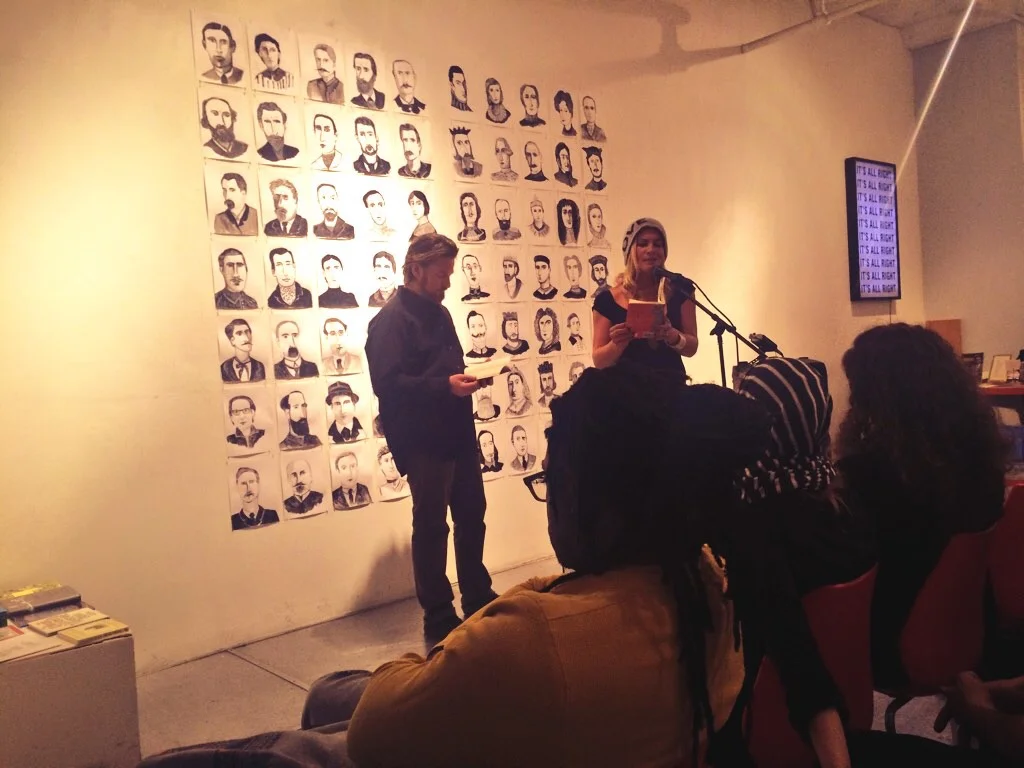
Leslie Flint Presents Stacy Szymaszek
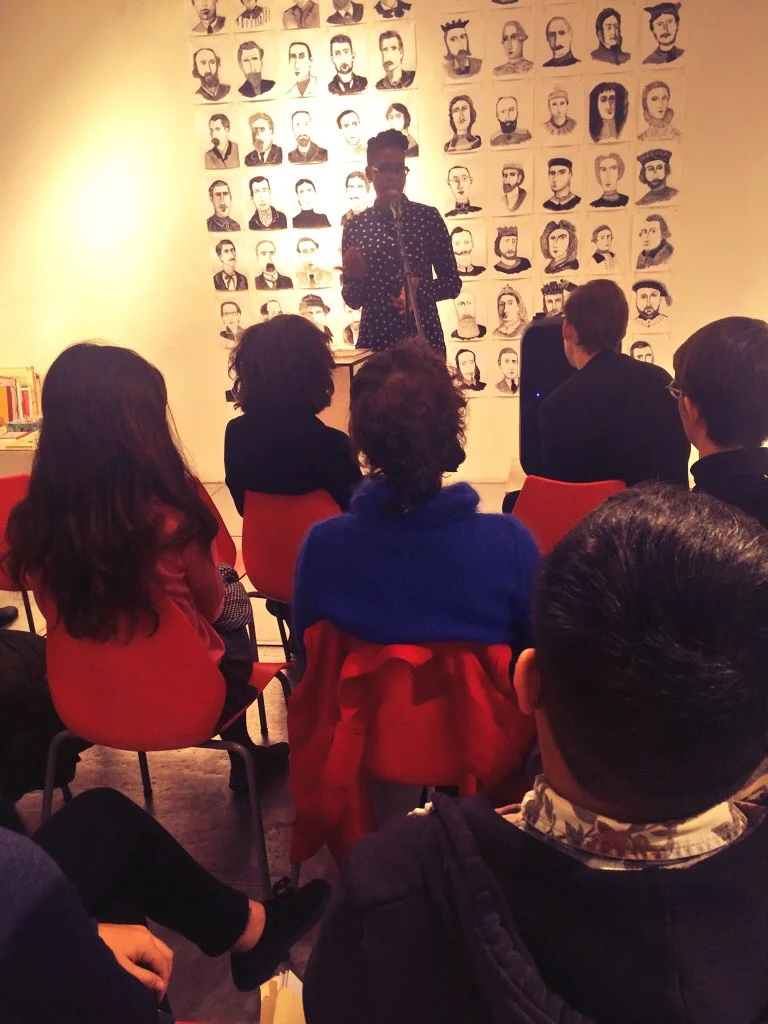
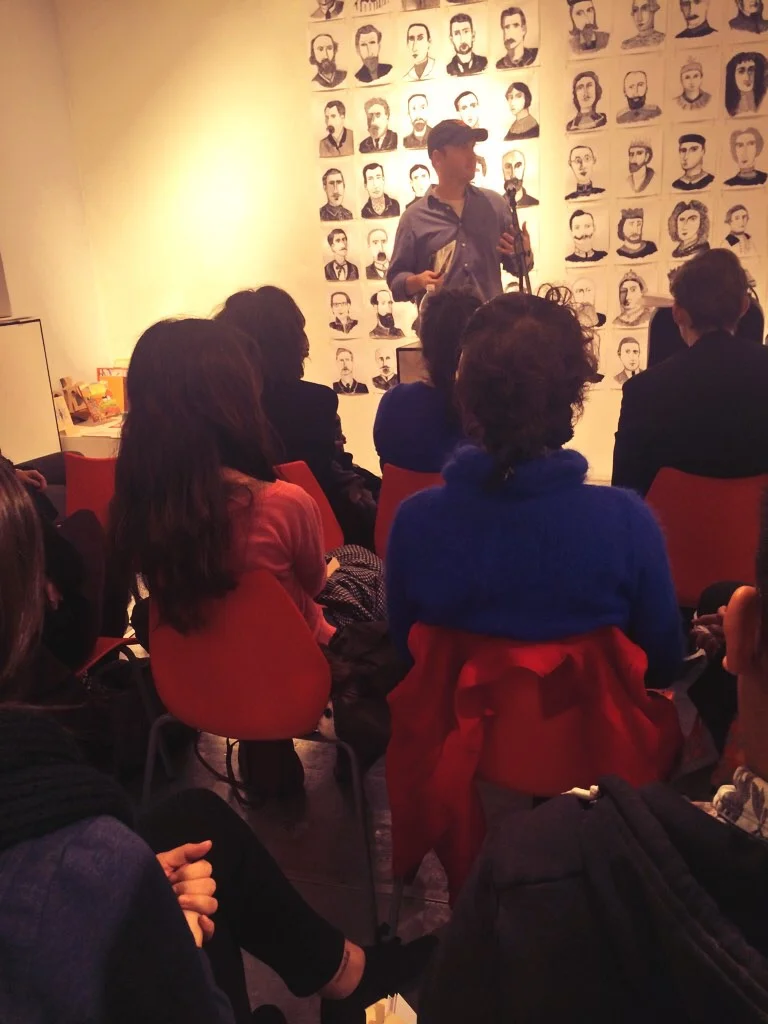
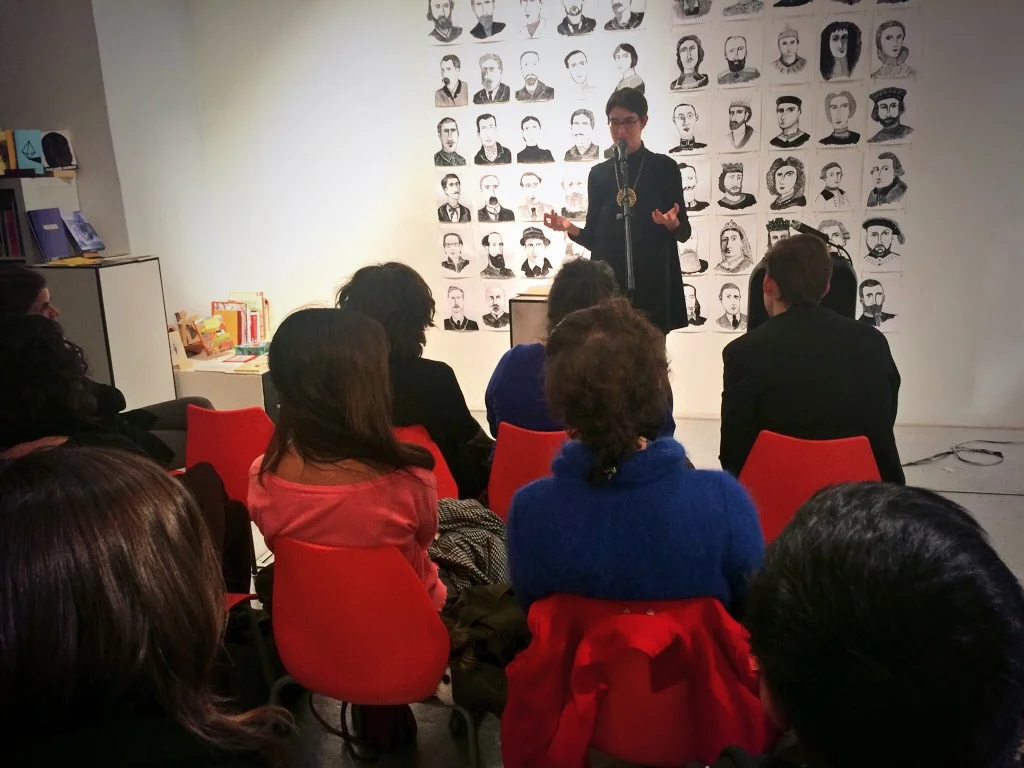
Because Jamie Townsend was traveling, the reading was hosted by Marissa Perel.
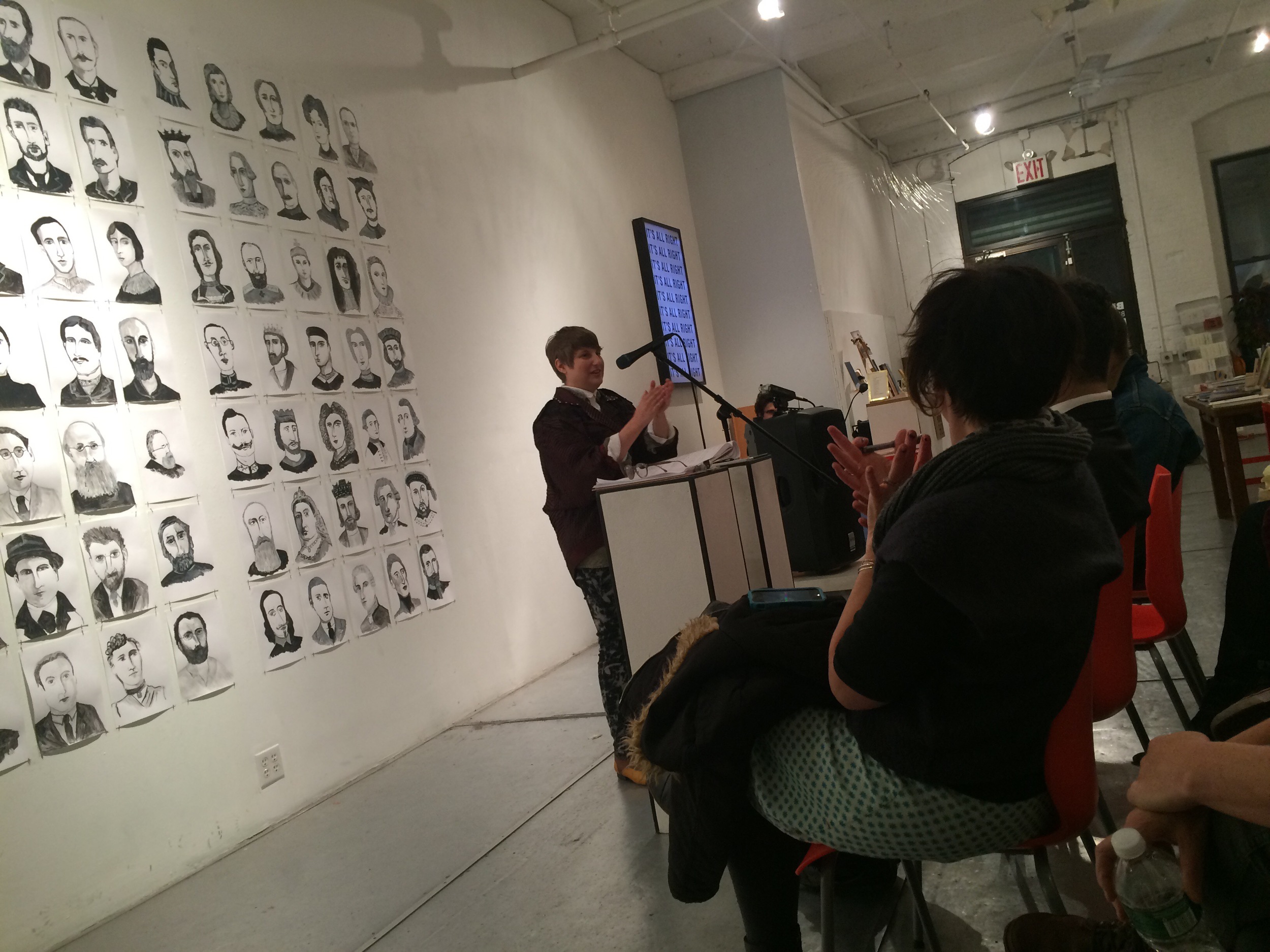
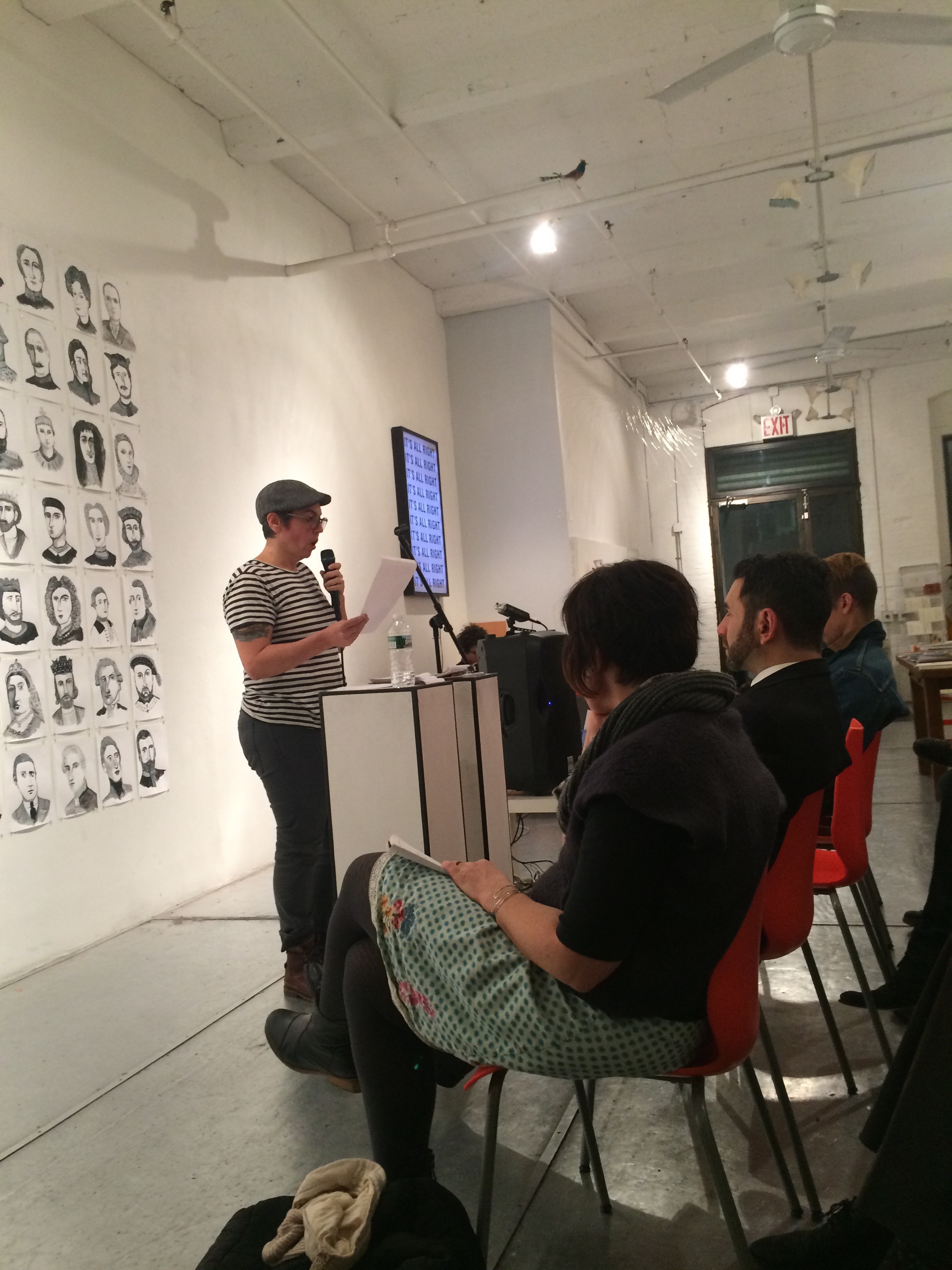
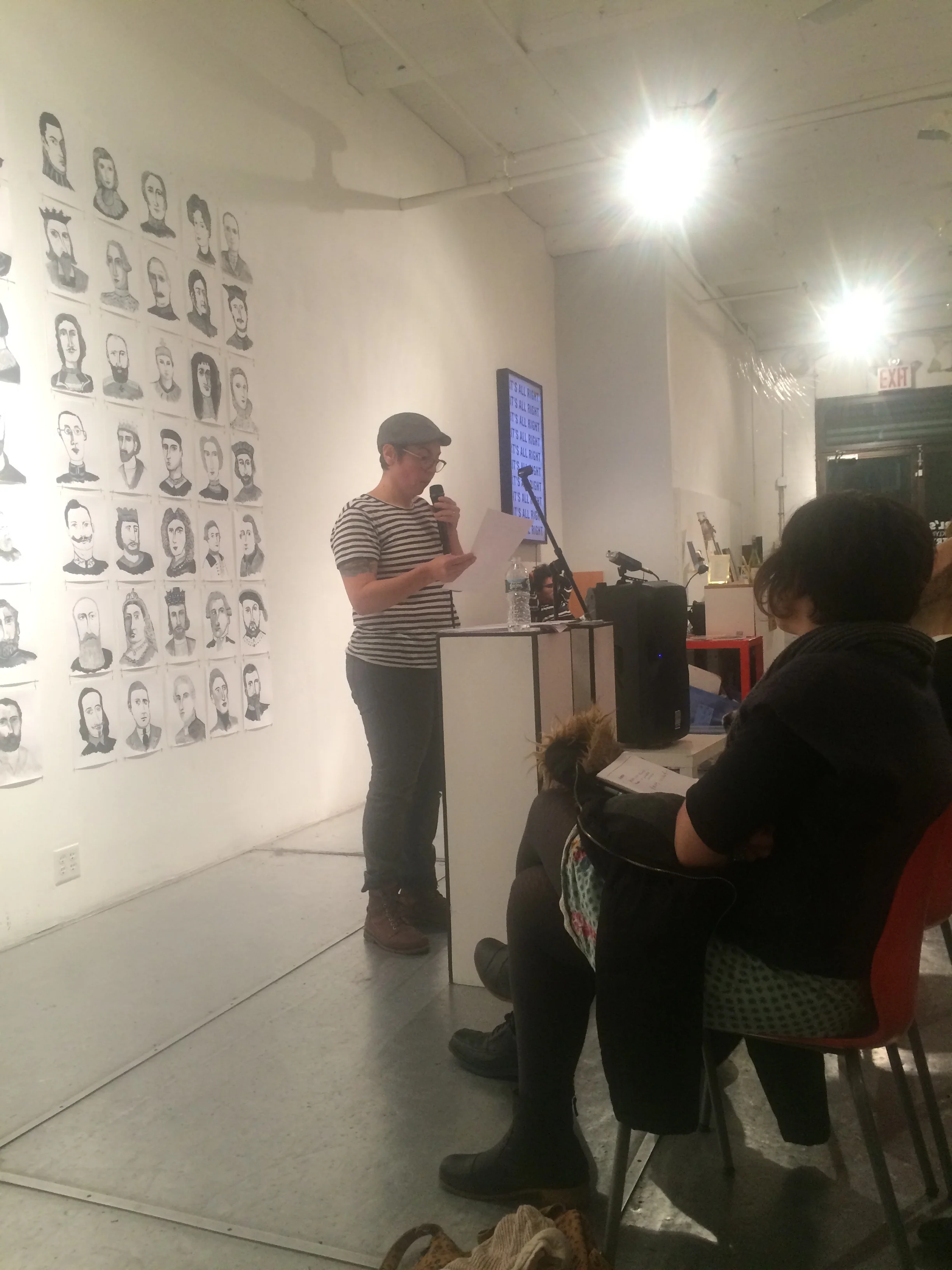

Because Jamie Townsend was traveling, the reading was hosted by Marissa Perel.
Here our our introductory notes prepared by Jared with assistance from Berl's interns, Samantha Maldonado and Victor Allen:
“Memento mori” hovers over both poets’ books tonight: Sandra’s Opens w image of Carcass of beef
and then the line on p 2 “Even a propped skull is human nature” “I am shot to death’ –Heim in a book full of beheading, bodies with holes in them, Holofernes (beheaded), etc. Both poets harness mystery (both the titles of their recent books suggest an expansiveness extending beyond the horizon, a maybe infinity that acts a corrective to death and solitude, the stuff we know.
“nature that begins with the unknowable and extends with more monotonous hills” – Sandra Lim
“Monochromatic searching for a monochromatic soul” –Stefania Heim
“lets get on our bicycles and ride around in the dark. In absence. In educated guess” - Stefania Heim
“Isn’t this a relationship with your death too to fall in love with your inscrutable life” - Sandra Lim
difference, Stefania is surreal, Sandra is interested in the trans-real or the hyper-real. “inside every world is another world trying to get out”
psychological SH vs theological SL.
SH is tight, cut to the bone, static like a photogrpahic, SL is more fluid, with sentences that move like brushstrokes. SH photo SL Painting
Finally color:
SH pink + purple, colors of the inside of the body “wild pink tree” “strange pink sky” “rosy thoughts” (SL has by way of contrast: “feelings keep opening their myriad dark flowers for you, their thousand petals of thought.)
SL: incarnadined cheeks, flower bouquet, maraschino cherry snow white+rose red
"my concavity and my chest"-SH “when this life is over, describe to me how its concave and convex forms are or are not” -SL
(memento vivere)
SANDRA LIM:
The Wilderness is about the wilderness within the self, the wilderness that emerges through writing.
Engaging “my lower self” and how writing does this “my soul, it wants to stay up, write through the night”
Sometimes it feels like Sandra’s poems take place outside the universe, as when writing about belief she offers “people tend to believe god believes what they believe” or zooming out from mentioning the suicide of an uncle we arrive suddenly on the pitch black line “think of a needle dropped into the sea”. In this voice of prophet we get these oratorical utterances like: “Maybe you can’t penetrate events with reportage but facts have a sly, unanswerable texture that appears social” and “We know what it’s like to fall in love and be disassembled but we still want to pull death right off the bodies of one another”. Prophecy that lands occasionally on an I who is a person who goes to concerts or mixes fancy cocktails and dreams of being inanimate “an odd Victorian mansion in a field of wheat” or When I grow up I want to be lightning” So though this work feels sybilline the prophet is just another reader watching the plot unfold-- “I just want to know what happens”
STEFANIA
A compact writer – a chapbook 3 poems – the chutzpah, the confidence/stylishness/poise to write 3 poems and say here it is, this is a chapbook.
Victor: submerged connections between strange, arresting images deployed in honed poems. effortless. this impression is given to us via the short length of the poems and the clarity of the language” Victor called her poems “plates of unexpectedness” and we were all struck by the pervasive aura of mystery hovering “cloud of heads” though the poems are crystalline.
The book is concerned with distance, landscape and desire. How desire moving outwards, across distances, mapping a landscape, and also inward, mapping a self.
A book about desire and how a self is built out of desires. I think of voltage, or electricity. Like the gap between lightning strike and rumble, when counting off seconds maps a distance in miles to the arbitrary spot where the bolt has hit and everything is singed: “A sound, not unlike the thrum of sustained thunder”
Also, it makes me think of chess, how the landscape of the board is the unexpected result of a series of interlocking maneuvers that are constantly creating the contemporary situation:
“it’s a dance of mechanics” ... “we move each other around”
a book in which there is always a desire that points somewhere beyond—over the next hill, out of frame, at the edge of an aperture: “what each admires is afar” “the water is farther off” “everyone else who matters hovers whisperingly off screen” “it isn’t here you wait, it’s around the bend” “all night dreaming at the edge of a cliff” “at the mouth of the bay” "blank where the sky has just opened up”
Theme: "motherhood has made me honest"/ anxiety about relationships “wife” “wed to it she is red” “a man is crawling and a woman is on fire”
Fear about relationships? "eventually tempered to a nice hostility” Stakes about being a wife and a mother. commitment “this thing is total”
Samantha on Stefania: to read this is to peer into the dream journal of a stranger who you can’t identify but you feel you’ve met before. Poems weird, lonely and lovely. Heim comments on the dream world in which the poems take place: today there’s no one who doesn’t look like someone I miss” and these poems reach into these in between spaces – between you and the person you want to be with, between where you are and where you wish you were.
An attempt to remember and write down dream but also how writing down the dream has the effect of ending it or even causing it to be forgotten. “What I fear is transformation” Stefania writes.
Here are Jared's notes towards introductions for the reading:
CHEENA MARIE LO’s PROJECT as described by ARIEL GOLDBERG & RACHEL LEVITSKY
Drawing these connection between a series of un/natural/disasters: the natural disaster, the breakdown of a house, the foreclosure of a home, the ambiguity of community, the loss of work and the impossibility of gender definition:
Threads : being read, relation of story, poetry and body, economics / communitarian, identity and naming
Cheena Marie Lo: “movement and relation” “To take the place of a name. This is a body.” “The physical form talks around an interpretation.”
Jim Goar: “this is my body. A nest for you to keep” “Once upon a time…”
Arisa White: "we go story after story thinking the roof will know nothing of the ground" – Arisa white
Katie Fowley: “Social dance”
Writing about body and its environment, and how language can both help and complicate our understanding of how these are connected. Language creating identity.
ARISA WHITE
A PENNY SAVED
Terrifying & Heartbreaking story of identity, violence, survival.
Runs bright red “in the pitch of a siren, suspended”
Cymothoa exigua “a parasite eats the fish’s tongue and becomes the tongue it has eaten”
unstable metaphor for domestic violence, instability of identity and identiffation
HURRAH’S NEST
Re her younger brother as a baby: “he was as foreign as the words in my workbook”
Writing “To not judge.” “When you walk in the world as black, woman, queer, poor, and the such, you get read before you reveal who you are. And sometimes, there is no space to learn who you are without being constantly challenged by assumptions, stereotypes, and expectations to perform or produce in a certain way because of those social identities.”
Stirring language:
“You, removed from the force of constellations”
“a silence that turns everything purée”
“you are bold letters among faded ink-whispers of people”
A publishing experiment:
I’m publishing 100 copies of dear Gerald, and will give out 95 copies to those who send me letters. (The remaining five books will be for me.) To receive dear Gerald you must be willing to give yourself healing attention. The book is my offering to your fearlessness, to sitting down and mining that pain, that absence, and then sharing it with me. It is no easy task to do that kind of work . . . .
Jim Goar
“I had the grail but lost it. Closed my eyes instead. Retired to the Florida Coast. The grail castle was no more. The dustbowl loomed. A life without shelter. I used to be a knight of the round table perilous. Surprised at how quickly things change. Predicted rain on opening day. And it rained. Blamed the radio for our loss. Notes from the deepest space. Our holy anthem continues to play.
Camelot/grail mythos interweave with Americana, but instead of the splenetic and ethereal comedy of Jack Spicer, we have sort of silky, diaristic, abstract sketches. Many fragment sentences without subjects that give it a static, lugubrious quality, like relics from a funeral rescued from the garbage.
“In every picture. Doors. Around every door. Debris.”
Goar turns language in on itself to find the “quest” in question or turn the pen into pen-dragon.
Interesting how it foregrounds the order of composition, and the fact that these are written in Norwich England as a sort of fantasia of America written as an expatriate.
“California is the Garden of Eden.” “knights from the heartland”
These poems take place nowhere but language, or I might say in the no where that is language.
Katie Fowley
Social Dance, which explores the relationship between poetry and dance
Mina Loy or Laura Riding Jackson / or maybe Russian suprematism or blakean in the mixture of children’s song meter and mythopoetic apocalyptic content
“using words in the wrong ways” says Katie Fowley as reviewer
“My name is turtle. My body is dark. Turn my body in the fire”
Lullaby (dactylic tetrameter a la Thomas hardy)
“lets all become nursemaids and sleep in low places. Let’s all become jelly in a spa of red hearts’
from her poem “Recognition”
“Before the event a man ranks as woman / before the event a woman ranks as man / a man rank as woman ranks a woman / a woman rank as animal ranks a man.”
Merging. Messy. Energetic.
Cheena Marie Lo: writing about the body. I found some extraordinarily provocative writing of Cheena’s on Jacket, where the body is discussed as a set of relations.
“learning how to be in my own body”
"i am learning how to be in my own body in relation to foreclosure and underwater mortgage rates. i am learning how to be in my own body in relation to 1 in every 730 housing units receiving a foreclosure filing in september 2012."
"I am learning how to be in my own body in relation to people I love fiercely and people I really like and people I kind of like and people I don’t respect and people who I never even think about and people I’ve never met and people I’d like to meet someday and people who I see from afar, in passing and people who will show up in the important ways and people who will show up only sometimes and people who will disappoint and people who will leave eventually"
"I feel like I have more conflict with myself, because I’m always so afraid of taking up space from others that deserve space too"
Cheena Marie Lo is deconstructing a lot of things we take for granted about the relationship between language and the body but I found this idea very compelling that there is also a cultural component to the pronouns Cheena uses, as when in an interview Cheena’s immigrant mother comes up: to quote “since English is her second language, she’s kind of bad with pronouns, but in this really subversive way that I am obsessed with. “ So in a sense the space to unsettle gender, for instance, arises out of the experience of being at a distance from language, from a learned or a native language...
talking around an interpretation – not even making meaning with language, but this language that sort of hovers around when meaning is made
lean into what is unknown
Everything is a symbol a gesture a referent. Nothing is a reference to this body.


Originally, this reading was expected to include Elizabeth Robinson, who was unable to attend. The first few minutes of audio introduction was unfortunately not recorded so this audio begins in the middle of the introduction of Brett Price. Here are Jared and Farrah’s notes towards their introductions of the readers:
Evie Shockley writes of “ethical waved around like a wand”
This is a reading of three poets committed to ethical practice in their writing, a potent mixture of gentle humor and outrage.
--
Brett Price is an ethical adventurer. I think he’s a little like batman, or Caine from Kung Fu except instead of wielding fists he wields poems. I remember the first time I met him – he’d recently returned from a trip of many days camping in the Andes - and we went on a tear in the backyard of a bar sharing notes about utopianism. Another time he left a party at our apartment and decided on the spur of the moment to scale the Manhattan Bridge, ninja style, up to the top of the tower in the middle of the night. . Right now he’s our personal angel, helping us to make Berl’s possible by babysitting our son.
Brett’s poems seem deeply inflected by questions of ethics; they revel in the quotidian and in leaps between transcendent and gritty or slangy language taking pure presentness, noticing as its organizing motif. Like the poem is a room that different characters might enter and exit unexpectedly:
"Several different kinds of same light come streaming and thank the blinds for my habit today / I beg histories in lung shaped motifs of air"
he uses a bicycle metaphor as well:
You’re on your bicycle
coasting ever smoothly
down this heavy-slanted street,
collecting and applying
so many ridiculous things:
Humble and humane this is, a poetry big enough for Rilke ("the torso of Apollo brilliant and archaic as a star") and grounded enough for Gertrude Stein-ish moments like this one from a poem Steven published in Sink review ("misconstrued bourge-alarm’s call mass produced")
ethical practice of writing – no distance between the self writing and the self thinking. His poems are concerned with how to be: “If this were that if that were this / things would be different" “begin again or simply continue different”
with friendship and in particular the ethics of these connections: "a tendency to transform the variety of themes into sketches of my friends"
and with writing time: "I am at 2:51 pm here you are but when / then now surely I is someone else but when I is elsewhere then where am I now / I am here again at 3:07 pm with a headache and happy to know for sure"
Brett’s poems are sometimes built of long interflowing tributaries of phrases, other times by intuitively juxtaposed language pieces like chunks of concrete; either way his work has the paradoxical quality of being both restless and expansive. I envision him wearing seven league boots so every step lands in another unexpected place. In an essay brett described poetry is a practice capable of performing cuts against the grain”; often the only period of the end of the sentence comes at the end of the poem.
Some examples of Brett’s work: “coffin static blackout swelling bruise gray layers surge carnation infant day”
OR, at the edge of legibility:
“bathing snags in a stream of forced harmonics studio that auto-tunes any note
fit to register dissonance monitor-feedback or click of pick guard in live play
having everything from the start a given suit suspicion grew of heir-to resumes
I mean the unwavering privilege of position”
I was recently blown away reading his poems in ELDERLY particularly this line: “kicks and whistles low-stakes posts to gather dough entered wholly”. The idea of entering low-stakes posts “wholly”, of finding depth and meaning even when the work is just making ends meet, is so totally admirable. Brett is all in.
I also found this, in an poem of Brett’s in the archives of Octopus magazine:
"I’m B to the R to the E double T
then P to the R to the I—C—E"
how is that in one of Brett’s poems?
Evie Shockley
THE NEW BLACK is a book full of history, a matrilineal elegy and outrage both racial and feminist, and it hits elegant high notes in formally diverse ways but also includes other things too: parties, sex, "cuddly dharma" and "untimely violet" evie's work is vast.
“Can a feeling change a structure?” She asks
In her work we are given the voice of Frederick Douglass, calligrams in the shape of an x that intersect a words from African and American to affectless, amorous, affordable, afterglow and affirmative, photographs of children full of attitude and sweetness, sonnets, John Cage-ish mesostichs. You turn the page and discover something new. In talking about poetry experimental usually means one thing, I have the feeling that any form for Evie is equally experimental.
What holds it together is this preternatural poise, this sense of palpable confidence that inspires rapidly a deep sense of trust.
Some of her poems are time machines, as when she juxtaposes herself with Thomas Jefferson, using a cut effect to deploy his words of the Declaration of Independence while describing his ethical failures on his own plantation. Complicating things further she inserts herself writing “in some world / an even newer one /I might have liked you / and you might have liked (not fancied) me/ we might have shared a bottle / a conversation some poems / in this world I prefer your words/ depending on them to be / better than you.”
This idea of language itself carrying potential that surpasses the world in which we speak is dark but also powerful and inspiring.
Getting around utopia the speaker closes her eyes and then opens them to stare hard at the sunshine on the California coast, almost but not quite past the edge of America "where the joy is muddy, picking itself up from puddles, where folks with lopsided smiles stare at rings stripped not of meaning but of status." I'm pretty sure this is an epithalamion, an occasional poem for a new wedding perhaps even a new kind of wedding. But the fact that it has its place besides dark poems where evie juxtaposes "it's going to be a bright sunshiny day" with her own observations like "murk is the new black".
ON DORK SWAGGER AND WRITING A BLURB FOR STEVEN KARL BY FARRAH FIELD
Even as I thought certain things, I knew they were so true yet never true. Dork Swagger doesn’t read like a first book of poems.
The expectation of poems is that they can’t do somethings. But over and over again people write poems that say things I never thought a poem would be able to say and put stuff in poems I never thought would fit. Do all poets write against this unspoken boundary? In grad school I remember someone getting mad because one of us burped during her poem. Why not? Why can’t a poem have a burp in the middle of it? And if the burp is so distracting to your ta-ta work, maybe the poem should include a burp because as soon as one thinks a poem can’t have a burp, that’s when it HAS to have a burp.
What is blurb writing anyway? It seems part review, part selling strategy. Jared says shorter the better. My professor Lucie blurbed my professor Timothy’s book by simply saying he’s a herd of one. That seems pretty powerful. I’d read a book from an author who is a herd of one. So what I’m going to say about Steven’s book in part will sell his book to people who look at the back hoping for a come here finger, hoping to be appealed to. READ THIS FUCKING BOOK YOU ASSHOLES!! In the past, mind you this is only the second book I’ve blurbed (perhaps one writes short blurbs after writing nearly one hundred of them) my approach to blurb writing was to sell a book plus say something about what it’s doing, to put that language out there. But when describing what a book does, the language is super poetic and weird. It’s like stacking metaphors on the ground and your baby walks by in Godzilla-like fashion and knocks them all down before shitting his diaper.
Because I’m such good friends with him, I had a hard time not saying this is what Steven does. I had a difficult time saying the poems do. Like the poems look at youth. Poems don’t really do that, they don’t really do anything except sit on the page. The ideas and themes are brought out in poems and it’s evaluating one’s youth and where it sits in culture and time is an idea within a poem and an idea flushed out of a book of poems.

Here are notes by Farrah and Jared for our introductions to the event:
SARAH ROSE NORDGREN writes “Content usually roots story to ground, but I sense it shivering around you when you turn half-asleep in bed, disturbed”
I felt these lines hovering as we were preparing the introductions for today and reading these poets, all of whom are playing in a space where content both tethers and shakes loose into an unknown universe. I love the idea of a poem’s content not only shivering around (as a sort of emanation of the cold world) but also seems to sort of snuggle the dreamer against the half-felt cold. And how poetry then becomes the disturbed dream that floats into the world.
Dara Wier
A kind laughter in Dara Wier’s poems spreads over the world, like a sprinkle of warm rain. She writes: “Like a rubber tombstone in a hailstorm”
There’s a balletic quality to her work, which seems sane and serene even when making hairpin turns or leaps into reverie, so that when it gets fantastical Dara’s tone gives it less a feeling of lifting off than of suddenly yoking to an unexpected ground, giving the chains a tug and maybe peeling back a bit of reality
“On the way a tree dematerializes and passes through your brain”
“I saw you quarter and corner and replace yourself with a turnstile"
Some poets when they seek to innovate ways of pacing poem deconstruct the line, or add spaces between words, or hyphens, or even quotation marks. Dara in her book REVERSE RAPTURE used parenthesis and I think in a sense she is a poet of the parenthetical - like someone quipping in your ear in the back of the room during a poetry reading. “One night one child wandered lonely as a cloud, or so it’s been reported.” The parenthesis is a funny effect in pre-announcing its own lack of necessity while turning out to be often where the real work happens. Parentheses are generous and as they stack one after the next they become like little adjacent universes that may or may not close.
Thus her poems unfurl in a subjunctive mode that is kind, reaching out, wry, and full of lush and playfully surreal analogies and hypotheticals “If I were not a socket wrench and I were a lug nut” or “Dream-ruffling things, as if we were carrying something as heavy as it is invisible” or “God is made of ice”
I see her work as a sort of opposite number to TS Eliot’s objective correlative in which the metaphors conform to emotions – instead we have in Dara a subjective correlative in which emotions restructure the world, irradiate objects with tone. She writes “what a pity feelings have feelings too” and very perceptively “I notice how often a smile is an apology”.
Her poems overflow with mystery whether it is human relationships : “I wonder what you wonder when you wonder” or language (as when dara pitches a poem into ambiguous spaces as in the lines “every other house was empty / every other house had someone living in it” so the poem takes place in the flicker between possibilities) or the self is a mystery. “Who signed your birth certificate” she asks in a poem called “Good Detective” and in another poem: “when they turned me over they found my back stamped with cryptic alphabets."
“I washed my brain and hung it to dry” The effect of reading her is a kind of mental floss – reading her work feels invigorating.
Sarah Rose Nordgren
Her book is very poetics of space. Like a glossy magazine called “Fairy Tale Living” Fairy tale people have the same problems we do. “inflicting only the right kind of violence"
Feminist: I remember seeing a show in Chelsea a few years ago depicting women in contorted poses weaving their bodies akimbo into wicker chairs. I was reminded of this in her line “the dark mahogany of your skin blends in perfectly with the other furniture”. bolts of lightning like this strike frequently in Sarah Rose’s work, often relating to a deconstructive, desolated view of marriage and the domestic “I get more creaturely every year” in a poem called “THE WIFE”. One of my favorite poems quips names for a country house such as ‘nightmare of ancestors’ “hungry attic’ and “broken monument”.
The book ends “to to be a mansion steering itself”. Elemental. There is a sense of poetry as a haunted house, or perhaps not haunted but alive.
Adam Fitzgerald
An aura of elegance that pre-exists content. “the rotund ministries of, say, moonlight” “vague pleasure of doubt." It’s a synesthetic sensibility that drapes objects and spaces in off colors to generate energy and mystery. “peach atrium” “azure doorway” “purpled cypress” “lilac covering their forehead" “all these matters of radial color. Schemes of highbrow living that used to interest you”
This mixture of the allusive and sonorous, the ironic and the emotionally committed, creates odd moments of humor that seem right “like a girl, dapper, chivalrous” so the gender flip clatters while we still get these just-so modifiers. These effects lend gravitas to occasions when Adam step forward to claim “There’s a big war being fought right now and it’s being fought without you
Sitting with Adam Fitgerald’s work makes me feel as though I could be sitting at a table with Edith Wharton or Katherine Mansfield. It has a timelessness that invokes a past or a future or a present, a particular diction “resting like the uncle-we-loved’s hat” and a particular way of being with people that doesn’t reek of the internet or the bombardment of popular culture but rather of culture “a town dreams itself along a river.” The Fitzgerald Culture is permeated with travel and books and reading and writing, feels as though we stopped at a podium in a far away museum to search for a familiar name in a sign-in book. Yet Fitzgerald Culture is not formal nor without anger “I will accost you like an idea caught in a fan”, but takes in snow the way snow is cold in Dr. Zhivago or in a painting. He effortlessly courts imagination and in so doing gives credence and voice to the dimension of poetry where those of who like it have thought and understanding. Adam Fitzgerald gives us camaraderie.
Bridget Talone
In an essay she wrote in grad school Bridget described how her first need for poetry came in adolescence in helping to process the trauma and distress relating to her father’s grave illness; she writes: I wrote in order to express my most painful and unsayable thoughts and feelings—to make some sense out of his, and my own, suffering. I wrote (in the words of artist & sculptor Louise Bourgeois) because my emotions were “inappropriate to my size.”
I think Bridget’s poetry often interrogates these questions of the scale, the giant and the small. Writing into this vein, she has: “my self foamed over its limits, toothless.” And, a longer passage: I touch my lips to your heart-fingers, wet-fingers, fingers dipped in shadowliquor. / when I gigantize my other senses”
The speaker in Bridget’s poems seems half gargantua, half infinitesimal, constantly seesawing between these disproportionate extremes of scale, king kong one minute, a tiny insect the next: “I’ll be all we swallowed: be figurine and miracle:” “the world a blinding ankle—“ “Now tell me how we became bee & crawled inside”
Her poems are littered with close up flowers. (“a flower-based suffering” Bridget writes, and “Tell the flower to stop over-sharing.”) and even closer up teeth (“The thoughts are cutting their pink teeth on you,”)
Pink comes up a lot – skin pink, perhaps, and bruise red. “Salt visions in the pink night, “ OR “I replayed our last looks / until they were pulpy (red & pink):”
She is writing about the bewilderment of grief. “When you died, you took the bugs and the music”
Paul Bunyan comes up in a poem of Bridget’s that Verse Daily republished from Salt Hill. She writes “ the only person I ever wanted to drown in my whole life was Paul Bunyan.” So there we have a profound fantasy about size – of there being an actual paul bunyan next to whom you would seem tiny, and then of being so big you could wield some hypothetically enormous body of water in which to drown this giant. I suppose that this enormous watersource is not so hypothetical though it’s just poetry.